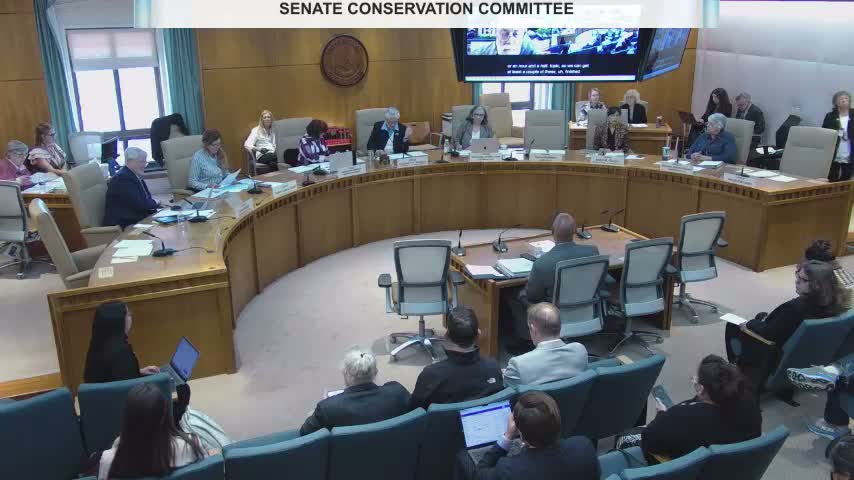
Senate committee tables bill to count nuclear in state renewable standard after heated debate
Loading...
Summary
A Senate committee debated SB 78 — which would allow nuclear energy to count toward the state's renewable/low‑carbon portfolio — hearing technical defenses of nuclear as dispatchable power and concerns about waste, uranium mining and statutory definitions; the committee ultimately tabled the measure 6‑3.
A state Senate committee on Thursday tabled Senate Bill 78, which would have allowed nuclear energy to be treated as an eligible technology under the state's renewable or low‑carbon portfolio standard, after extended questioning and partisan debate.
Supporters, led by sponsor Senator Thornton, argued the bill merely opens planning options for dispatchable, always‑available power. Thornton said the measure “just says now we can start planning for nuclear,” arguing that nuclear — especially small modular reactors — can help utilities meet the state's 2050 zero‑carbon target. He and his technical witness emphasized limits of battery storage and intermittency of solar and wind, noting that batteries commonly provide only a few hours of backup and that long outages require a dispatchable baseline resource.
Opponents raised safety, waste management and equity concerns. Senator Cynthia Lopez said that by common understanding “renewable” means a source that is constantly replenished and expressed alarm over long‑term fuel availability and the state’s history with uranium mining. Senator Charlie said the bill would let utilities comply “on paper” without driving new in‑state renewable generation and stressed the bill could centralize power and revive extractive resource activity in communities that have already been harmed by uranium mining.
The committee’s questioning covered technical topics and policy tradeoffs. Thornton cited U.S. Navy experience with nuclear propulsion to argue for the technology’s safety record and pointed to examples like France, which recycles fuel, as models for reducing waste. He acknowledged that commercial fission currently stores spent fuel on‑site and described national storage policy as a political question, citing Yucca Mountain as a long‑running example of the unresolved U.S. approach to a single federal repository.
Lawmakers also discussed whether the bill would affect only future in‑state development or simply permit utilities to count out‑of‑state nuclear power toward compliance. Thornton said utilities already accept electricity from plants such as Palo Verde and that the bill would make nuclear an explicit option rather than require immediate in‑state construction.
After debate, members voted to table SB 78; the chair announced the motion to table passed on a 6‑3 roll call. No immediate change to statutory regulatory authority was enacted by the committee. The bill’s sponsor said the measure was intended to provide planning certainty while permitting standard federal regulators — including the Nuclear Regulatory Commission — to continue overseeing safety and licensing.
What happens next: SB 78 is tabled in committee and will not advance this week. Proponents said they may continue technical work and stakeholder outreach; opponents said the discussion highlighted unresolved concerns about waste storage, community impacts and whether relabeling existing out‑of‑state nuclear purchases advances the state’s renewable goals.