Get Full Government Meeting Transcripts, Videos, & Alerts Forever!
Get email alerts on the Medical Privacy topic
No spam. Unsubscribe anytime.
Committee advances substitute for bill to strengthen privacy protections at reproductive and gender‑affirming care sites
Summary
The House Health and Human Services committee voted 6‑2 to advance a committee substitute to HB 279 that tightens protections for sensitive reproductive and gender‑affirming health information, limits geofencing near clinics, clarifies EMTALA‑related duties and permits certain dispensing‑label protections for medication. Supporters said it protects patients and providers; some members voiced concerns about research access and overbroad protections.
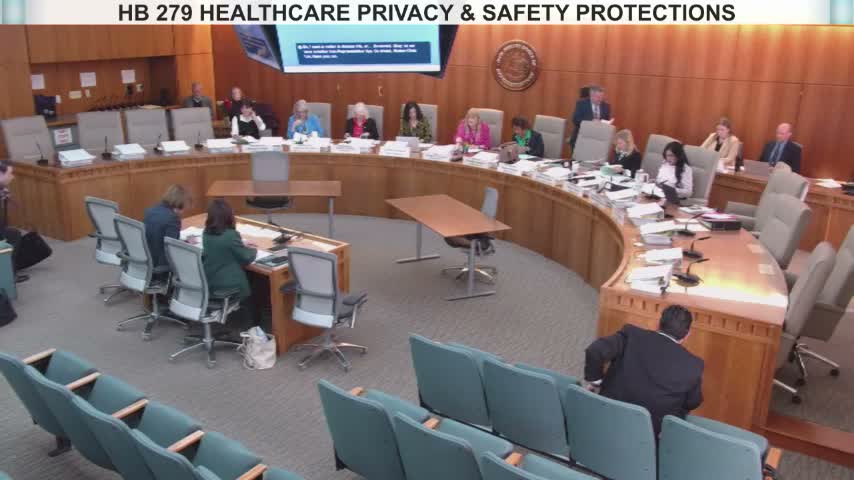
The House Health and Human Services committee on an unspecified date voted 6‑2 to advance a committee substitute to House Bill 279 that sponsors and backers said would bolster privacy and safety for people seeking reproductive and gender‑affirming health care.
Supporters described the substitute as a narrowed version of an earlier draft and said it focuses on preventing out‑of‑state actors from obtaining sensitive health information. An advocate for obstetricians and gynecologists told the committee the measure "helps ensure OB‑GYNs can do that safely, ethically, and without fear that patients' private medical information could be weaponized by out‑of‑state investigators." (Deborah Condit, American College of Obstetricians and Gynecologists)
The substitute, as explained to the committee, would: add protections to state code (including revisions keyed to section 24‑35‑4 and to hospital licensing language), prohibit geofencing around facilities that provide in‑person reproductive or gender‑affirming care with limited exceptions for security or direct patient‑service uses, clarify stabilization and emergency‑care duties aligned with EMTALA, and allow clinicians who prescribe abortion medication to keep their personal name and address off dispensing containers while identifying the dispensing facility.
The Health Care Authority supported the substitute, saying it clarifies that emergency departments must stabilize pregnancy‑related emergencies and strengthens confidentiality for sensitive health information so patients are not delayed in receiving care. "House Bill 279 gives doctors and hospitals clear standards," said Carrie Armijo, cabinet secretary of the Health Care Authority.
Committee members sought clarification on how the measure interacts with federal privacy law. The sponsor’s expert, Ellie Rushforth, described the substitute as "a complement to HIPAA," adding the state language is intended to provide an additional layer where disclosure is otherwise permissive. Rushforth also told the panel she removed a more expansive data‑segmentation proposal from the substitute and said protections for legitimate research purposes were retained in the geofencing section.
Opponents were limited in number at the committee level; most witnesses including civil‑liberties and health‑advocacy groups urged passage. Meredith Machin of the League of Women Voters asked lawmakers to preserve reproductive autonomy and privacy. Supporters argued the bill is intended to protect patient safety and provider privacy amid what they called a national trend of attempts to use health records to pursue investigations of reproductive and gender‑affirming care.
Representative Jones, who voted against advancing the substitute, said she supported patient privacy and safety but worried the measure "has a chance this goes too far," explaining her no vote as a caution that protections not be extended so broadly that needed information for oversight, research or clinical quality is obscured.
The committee record shows a motion to recommend "do not pass" on the original bill and "do pass" on the committee substitute; the motion was approved on a 6‑2 roll call.
The measure now moves to the next stage of the House process where it may be considered by the full chamber or referred to another committee.