Committee advances math bill that requires early screeners and new teacher-prep coursework
Loading...
Summary
The House Education Committee adopted an amendment and gave a do-pass to Senate Bill 29, which creates a statewide math framework with early screening and family notification and requires additional mathematics methods coursework for teacher preparation pathways. Supporters cited low proficiency and workforce needs; districts urged more study on timeline and capacity.
Representative Sarnana presented Senate Bill 29 as a statewide framework to strengthen mathematics instruction by increasing teacher preparation requirements, creating statewide instructional leadership, requiring LEA professional learning plans and introducing screening and family notification for K–3 numeracy.
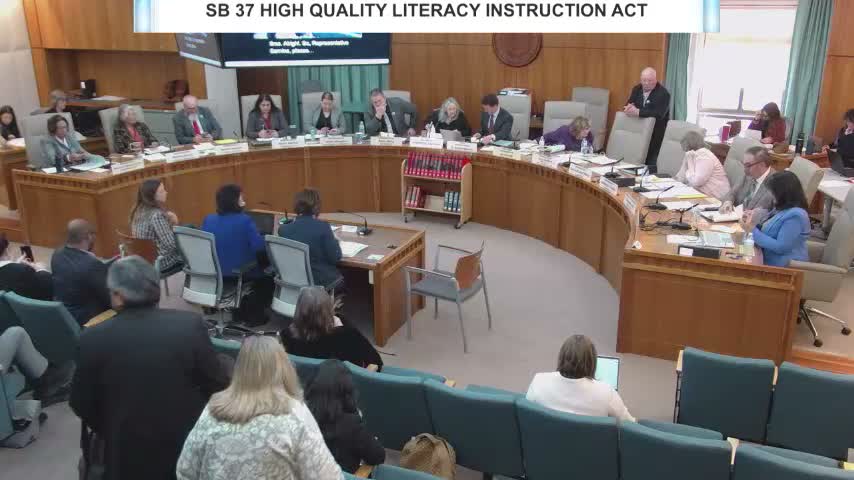
The committee adopted an amendment, modeled on SB37’s parent-notification language, to require districts to provide parents with written progress reports at least four times each school year. Sponsors said SB29 emphasizes quick classroom numeracy screeners (short formative tools teachers can use in a few minutes) and early intervention rather than wide-scale, time-consuming assessments.
Supporters included educator-prep representatives, math advisory councils, business groups and teachers, who argued teacher preparation and early screening are necessary to address the state’s low math proficiency. Opponents (including several superintendents and Clovis Municipal Schools) said the bill’s timeline felt rushed and that key measurement work — a quantile-like study to calibrate proficiency — should be done in the interim; they also flagged unfunded expectations for high-dosage tutoring and potential staffing impacts.
A point of contention among committee members and higher-education witnesses was the bill’s proposal that certain licensure pathways include two math-methods courses (six credit hours). Deans and sponsor representatives said the requirement is being phased in to allow colleges time to adapt; some members warned that adding credit-hour requirements will require curricular planning and faculty hiring at universities.
The committee voted to give SB29 a do-pass as amended; the sponsor and PED committed to continued work with higher-education institutions and to a multiyear evaluation of implemented math professional development.