
House commerce committee advances bill to regulate gun dealers and ban future sales of certain weapons after lengthy public hearing
Get AI-powered insights, summaries, and transcripts
Sign Up Free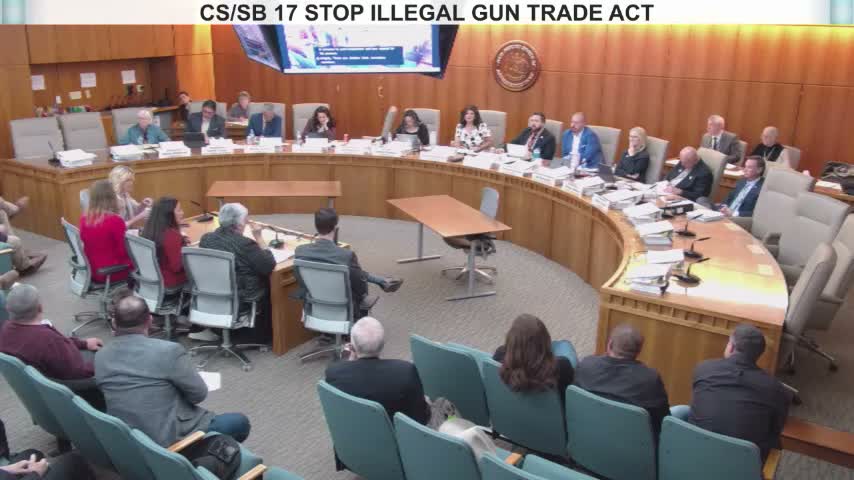
Summary
After more than four hours of testimony and debate, the House Commerce and Economic Development Committee issued a due‑pass recommendation for the Senate Judiciary substitute to Senate Bill 17, a package that requires stronger dealer security and oversight and would prohibit future sales of certain gas‑operated semiautomatic firearms, 50‑caliber rifles and magazines over 10 rounds. The motion passed 6–5 following an unsuccessful amendment to strip the weapon bans.
Senate Bill 17, presented by Sen. Debbie O’Malley as a gun‑crime prevention measure, won a narrow committee recommendation after an extended public hearing that drew hundreds of speakers and sustained questioning from committee members.
"SB 17 is a gun crime prevention bill," Sen. Debbie O’Malley said during her opening presentation, describing provisions that would require licensed firearm dealers to secure inventory, train employees to identify straw purchases, report thefts, and prohibit future sales of what the bill calls "extremely dangerous weapons." Sponsors said the bill targets trafficking and mass‑shooting risks rather than lawful ownership of presently owned firearms.
Supporters, including victim advocates, health professionals and prosecutors, urged the panel to approve the measure. Mariana Mitcham, senior industry adviser at Everytown and former ATF field official, told the committee that trace data show a high proportion of crime guns originate from in‑state sales and that more granular state reporting would help identify disproportionate sources of trafficked weapons. "We can require gun dealers to secure their premises, inventory, run background checks, and train their employees," she said.
Opponents—led by trade groups and numerous small business owners—warned the bill would impose heavy compliance costs, threaten jobs at local federally licensed firearms dealers (FFLs), and invite constitutional litigation. Nick Tuccio, state director for the National Rifle Association, urged rejection on First, Second and Fifth Amendment grounds, arguing the bans would be vulnerable to challenge under current Supreme Court precedents. "By moving forward with these bans, the state is inviting an immediate constitutional challenge," Tuccio said.
Committee members engaged sponsors and expert witnesses on three main themes: (1) whether trace data justify the proposal, (2) the fiscal and operational burden on dealers and the Department of Public Safety (DPS) to inspect and store sensitive data and surveillance footage, and (3) legal risk under current Second Amendment jurisprudence. Sponsors pointed to ATF trace statistics cited in testimony and to other states that have enacted similar restrictions; legal counsel and outside experts discussed the differing circuit‑court treatments of assault‑weapon bans since Bruen and more recent Supreme Court pronouncements.
Representatives pressed sponsors on concrete numbers. The bill’s supporters said training, reporting and secure storage requirements mirror federal guidance and NSSF best practices, and that DPS would promulgate rules, leaving small‑dealer exemptions for home‑based sellers or those selling fewer than 10 firearms annually. DPS cost estimates cited in testimony included multi‑hundred‑thousand‑dollar setup costs and additional ongoing FTE needs, which opponents argued risked diverting scarce enforcement resources.
An amendment (234004.1) offered on the floor would have struck section 7 of the bill—the portion that prohibits future sales and transfers of enumerated weapons and magazines—while preserving dealer security and reporting requirements. Debate on the amendment centered on whether a regulatory package without the sales ban would sufficiently disrupt trafficking. The amendment failed on roll call, 5–6.
Following additional debate, the committee considered motions including a tabling motion that failed. The final committee motion was to give a due‑pass recommendation to the Senate Judiciary substitute for SB 17; the motion carried on a roll‑call vote, 6 yes to 5 no. Representative Matthews, explaining his vote, said the human cost of gun violence shaped his choice to support the measure despite constitutional questions raised in the hearing.
What the committee advanced is a package that pairs new dealer security, reporting and oversight with a prospective ban on specified future sales; it does not seize guns already owned. Sponsors said the law would be implemented via DPS rulemaking with phased compliance timelines and limited exemptions for low‑volume or home‑based sellers.
Next steps: the committee’s due‑pass recommendation forwards the Senate Judiciary substitute for further consideration in the House process and likely additional floor debate and potential legal scrutiny. Pending that review, the measure’s constitutional durability is likely to be tested in court if enacted.
Ending: the committee completed its business and adjourned after the final vote, with proponents and opponents signaling continued engagement as the bill moves through the legislative process.