Lifetime Citizen Portal Access — AI Briefings, Alerts & Unlimited Follows
Deep Green pitches 24-MW downtown data center; council hears hours of questions and nearly 90 public comments
Loading...
Summary
Deep Green Technologies presented a proposed 24‑megawatt, heat‑reuse data center for a downtown Lansing parking lot, pledging closed‑loop cooling, heat delivery to the Lansing Board of Water and Light’s hot‑water loop, union labor and no local construction incentives; council members and residents pressed the company and BWL on water, emissions, generators, enforceable commitments and the suitability of a downtown site.
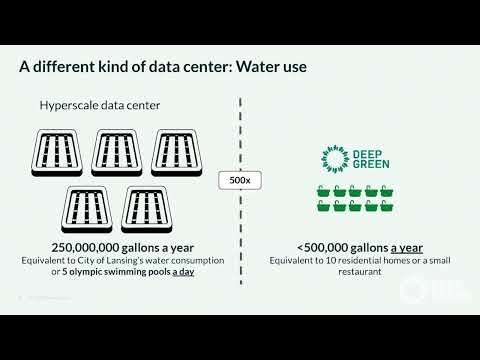
Deep Green Technologies told the Lansing City Council on Monday that it intends to build a 24‑megawatt data center on an underused downtown parking lot and to supply recovered heat into the Lansing Board of Water and Light’s (BWL) planned hot‑water network. "We will operate with closed loop cooling," Deep Green Chief Executive Mark Lee said, adding the company expects to use "less than 500,000 gallons per year" of water and to prioritize local jobs, union construction and community benefits.
The presentation and a following two‑hour council question period focused on technical details and enforceability. Mayor and council members repeatedly pressed the company and BWL for documentation, independent studies, and binding agreements. Council Member Dianeita Nevarez Martinez asked for Deep Green’s U.S. incorporation papers, bylaws, a director list and financial statements; the company said it would provide corporate documents and that Octopus Energy Generation is a principal backer.
Why it matters: the project sits at the center of competing priorities in Lansing — economic development and job creation versus downtown land use, environmental protection and local control. Deep Green describes the site as a compact urban data center that will deliver "free heat" to downtown customers, produce property taxes and bring construction and technical jobs; opponents said the proposal risks increased local emissions, noise and water or rate pressures without binding community safeguards.
Company claims and city scrutiny
Lee framed Deep Green’s design as an alternative to "hyperscale" sites that consume far more power and water. He said the Lansing facility would run on roughly 20–24 megawatts of computing load, be sited on about 2.5 acres, and use closed‑loop, glycol‑based cooling so there would be "no discharge to the local environment." He also said the project would rely on 8 megawatts of existing grid capacity plus 16 megawatts of on‑site fuel cells paid for by the developer, not by BWL.
Councilors asked for the underlying studies and independent reviews. "If that was requested as part of the process, we will have provided this," Lee said when asked about energy and water studies; he added the company would share further documentation. Technical staff for Deep Green and a company engineering lead, Matt Craggs, characterized closed‑loop cooling as more efficient over a full year but acknowledged the approach requires site‑specific design, and that engineering choices (including chillers and plant selection) remain to be finalized.
BWL’s role and the proposed power plant
BWL officials said they are a project partner on the hot‑water loop and that the Deep Green site sits near pipes planned for conversion from steam to hot water. BWL confirmed the initial heat supply from Deep Green would capture a portion — not all — of downtown heat demand and that additional modular plants may still be needed as the system is built out. BWL also outlined that the developer would pay infrastructure costs and that the utility expects to own and operate some of the generation in the event of customer departure.
On standby generation, Deep Green said the number of backup generators depends on final design and reliability targets; preliminary estimates ranged from four to ten engines, with fuel options including hydrogenated vegetable oil (HVO) as a preferred low‑sulfur fuel, though natural gas may be required depending on fire‑marshal and storage constraints.
Public reaction and competing frames
Nearly 90 residents and stakeholders signed up to speak. Labor and trade associations — including local IBEW and construction unions — urged approval, citing the project’s $120 million private investment, union construction jobs and long‑term tax revenues. "This project will create local union work ... and family sustaining wages," said a union representative, noting pensions and healthcare tied to union jobs.
Opponents — including students, environmental advocates, neighborhood residents and campus groups — urged council to reject rezoning to industrial. Speakers raised worries about water use, greenhouse‑gas emissions from on‑site fuel cells, the absence of legally enforceable community benefit agreements, noise and the downtown location’s compatibility with housing and pedestrian uses. "There is nothing legally binding about their claims," one student told council.
Council actions, process and next steps
Council did not vote on the Deep Green rezoning at this meeting. The council set public hearings and asked staff for documentation; city attorneys and BWL representatives noted that enforceable measures are most likely to appear in property purchase contracts and service agreements rather than in informal pledges. Council members asked the administration to provide a tax‑revenue breakdown and to explore options such as a development agreement (UDA) or contractual terms in the sale that could make certain community commitments enforceable.
Votes at a glance
- Motion to approve printed proceedings for 01/26/2026 and corrected proceedings for 01/12/2026 — carried by voice vote. - Motion to suspend Rule 9 for late items — carried by voice vote. - Resolution approving settlement in Hulan v. City of Lansing — moved and adopted in closed session; terms withheld as permitted by counsel. - Ordinance adopted to rezone 3310 West Mount Hope from R‑1 to MFR (allows a 29‑unit apartment building): roll call 8 yeas, 0 nays (ordinance adopted). - Ordinance adopted to rezone property on Island Avenue from R‑3 to MXC (for accessory parking): roll call 8 yeas, 0 nays (ordinance adopted).
What’s next: council set public hearings and committee referrals for the Deep Green‑related items (sale of city property and conditional rezoning). Council requested that Deep Green and BWL provide requested engineering, environmental and financial studies, and that city staff return with clarifying legal options for enforceable commitments in the sale and service agreements.
Sources: presentation and Q&A by Deep Green leadership (Mark Lee; Matt Craggs), exchanges with BWL staff, councilmember questions and public testimony recorded in the council’s February 9, 2026 proceedings.