Get Full Government Meeting Transcripts, Videos, & Alerts Forever!
Get email alerts on the Community Schools Outcomes topic
No spam. Unsubscribe anytime.
California study and state reports link community schools to lower chronic absence, fewer suspensions and modest test-score gains
Summary
A Learning Policy Institute matched study of early grantees and state implementation reports presented at a California State Assembly hearing found community schools reduced chronic absence and one-day suspensions and produced modest academic gains, with larger effects for historically underserved students; witnesses urged sustained funding and a June outcome study to probe mechanisms.
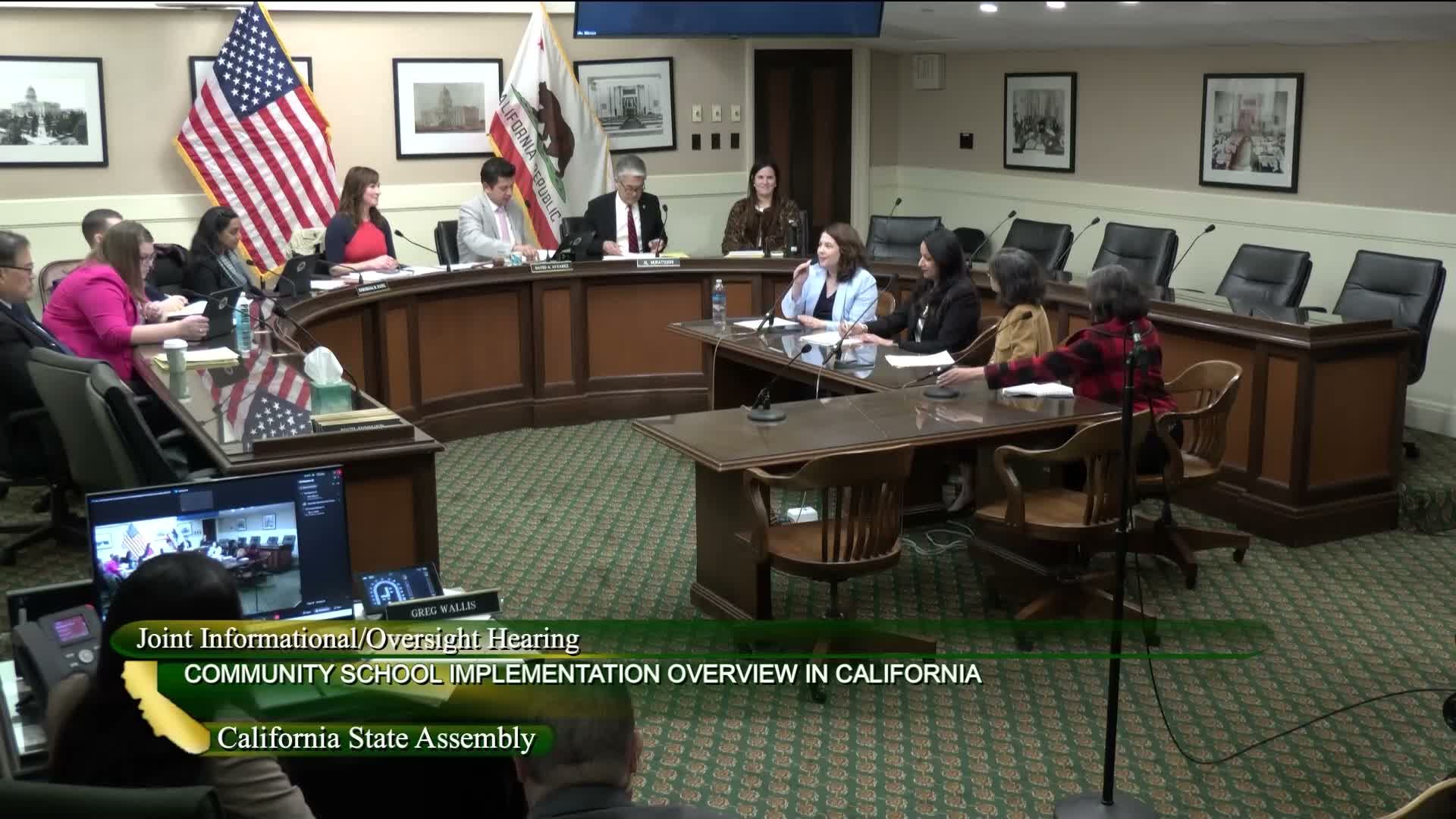
The California Community Schools Partnership Program has been associated with substantial reductions in chronic absenteeism, declines in one-day suspensions and modest gains on standardized tests among early grantees, presenters told a joint California State Assembly hearing on community schools.
"After a full year of implementing the grant program . . . community schools reduced chronic absence rates by about 30% more than the comparison schools," Anna Mayer of the Learning Policy Institute said in testimony summarizing a matched comparison study of the program’s first cohort. Mayer also reported that community schools decreased one-day suspension rates by about 15% on average and produced learning gains roughly equivalent to a quarter of a grade level in math and one-fifth of a grade level in English language arts.
Ingrid Burberson, chief deputy superintendent at the California Department of Education, told the committees the program—created by the Legislature in 2021 and authorized through June 2032—now supports nearly 2,495 grantee schools and has directed planning and implementation grants, technical assistance, and coordination funding across county offices. "Between 2021 and 2022, the legislature invested over $4,000,000,000 in community schools," she said, summarizing award totals and the state’s four-pillared framework (integrated student supports; family and community engagement; collaborative leadership; extended learning time).
UCLA researcher Marisa Saunders described the annual progress report as an implementation and improvement tool that captures capacity building, partnership engagement, the provision of whole-child supports, and locally determined metrics. Saunders said grantees reported more than 2,000 local measures in Year 3 and that an outcome study, incorporating Year 3 implementation findings, is scheduled for release in June to test which implementation practices drive results.
Panelists and researchers were careful to note that the LPI study used matched comparison schools and statistical controls to separate program effects from concurrent policies such as universal meals or behavioral health investments. "The comparison schools also had access to the same programs and funding sources," Mayer said, explaining the matching design intended to isolate the added effect of the community schools grants and practices.
Speakers highlighted equity impacts: Mayer and others said gains were larger for historically underserved groups, with the LPI analysis estimating particularly large effects for Black students (the equivalent of approximately 130–150 days or two-thirds of a grade level in combined learning gains for math and ELA in the subgroup analyses). Panelists emphasized that relationship-building, family engagement and school climate improvements are plausible mechanisms linking attendance and learning outcomes.
Committee members asked for more detail on outliers and causal pathways. Saunders and Mayer said case-study work and the upcoming June outcome study will examine which implementation strategies—such as shared decision-making, staffing models and integrated services—are most strongly associated with the measured outcomes.
The hearing closed with the committees noting an April follow-up hearing on the governor’s budget proposal; witnesses and members urged that the June study and continued monitoring inform budget and policy choices.