
Legislators hold hearing on eliminating California’s ‘water’s edge’ election amid budget shortfall
Get AI-powered insights, summaries, and transcripts
Subscribe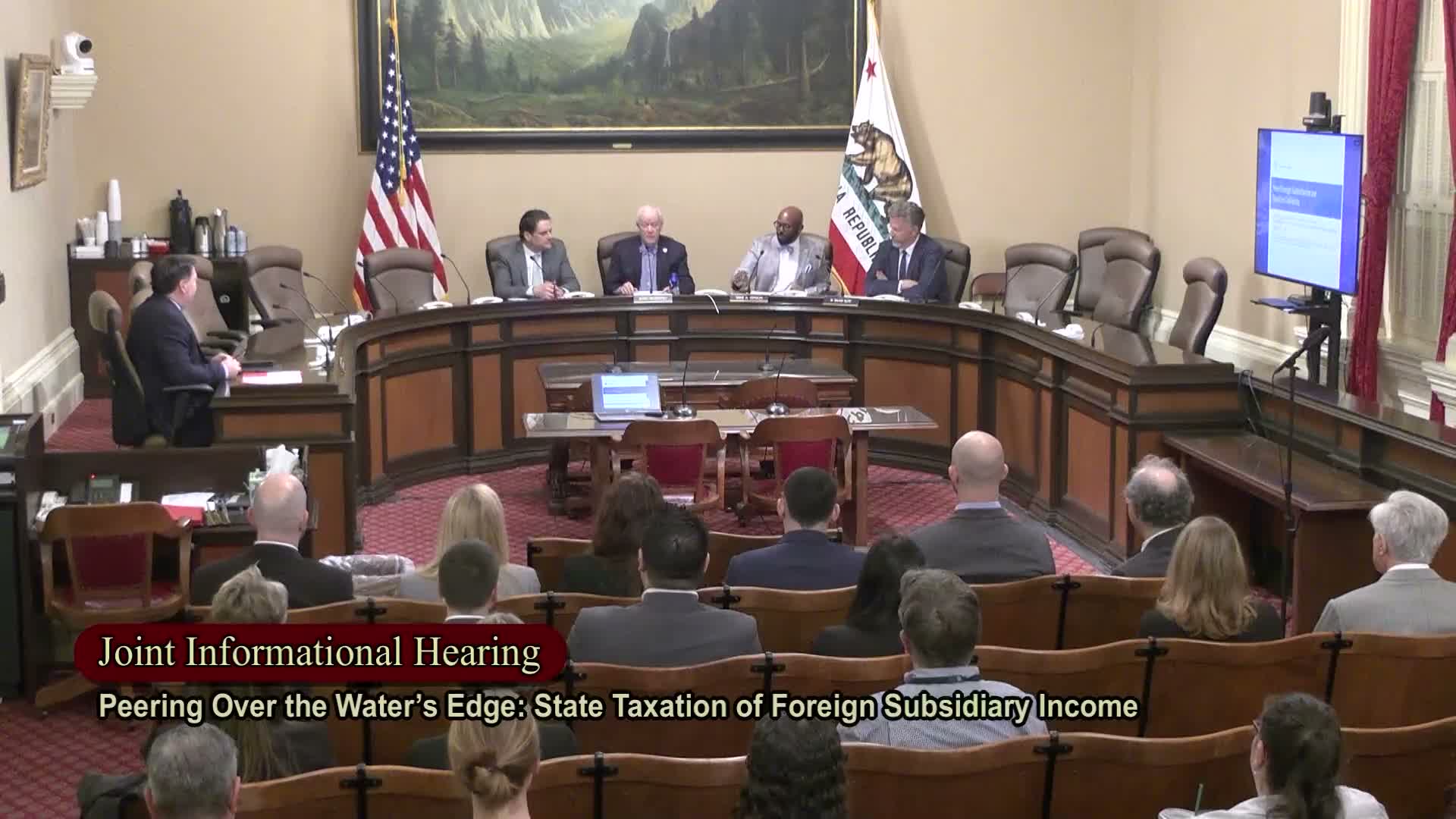
Summary
A joint Senate–Assembly informational hearing examined whether to require worldwide combined reporting rather than allow the water’s edge election; witnesses gave divergent estimates of revenue gains (low‑single‑digit billions to larger but uncertain figures), while agencies flagged data limits and administrative, litigation, and international risks.
California legislators held a joint informational hearing to reassess the state’s "water’s edge" election — the statutory option that lets some multinational corporate groups exclude much foreign subsidiary income from California combined reports — and to weigh proposals to require worldwide combined reporting.
Witnesses from the Legislative Analyst's Office and the Franchise Tax Board described how unitary taxation and apportionment work in practice: California uses a unitary approach that looks at related entities together and apportions taxable income to the state largely by the share of sales in California. The Franchise Tax Board (FTB) reported approximately 21,562 Form 100‑W (water’s edge) returns in 2023 versus roughly 337,000 Form 100 worldwide returns; water’s edge filers represent about 6% of C‑corporation filers but account for roughly half of corporate tax liability, the FTB said.
Experts and advocates were sharply divided on the likely consequences of eliminating the election. Professor Darren Shainski (panel witness) presented academic and IRS data suggesting meaningful profit shifting to low‑tax jurisdictions and estimated that eliminating shiftable income could produce revenue gains in the low single‑digit billions of dollars for California, while acknowledging substantial uncertainty. Jared Walczak of the California Tax Foundation and other business‑group witnesses warned that mandatory worldwide combined reporting can import foreign economic activity into California’s tax base in ways that dilute apportionment, risk double taxation with foreign tax systems that use separate‑entity accounting, and invite litigation and international pushback.
Both sides and the FTB emphasized uncertainty. The LAO and FTB said direct observation of foreign affiliates is limited when taxpayers elect water’s edge, making revenue estimates dependent on assumptions. Witnesses discussed transitional approaches — phasing, targeted reforms for the largest taxpayers, or piggybacking on federal measures such as GILTI/NICD or Pillar 2 — and urged complementary anti‑abuse rules.
Public commenters, including teachers, nurses and union representatives, urged the Legislature to close what they called a corporate tax loophole so more revenue could be directed to education, health care and other services amid federal cuts.
The hearing produced no formal action; committee members requested clearer slides and follow‑up analysis on revenue sensitivity, litigation exposure and transition timing. The committees adjourned after public comment.