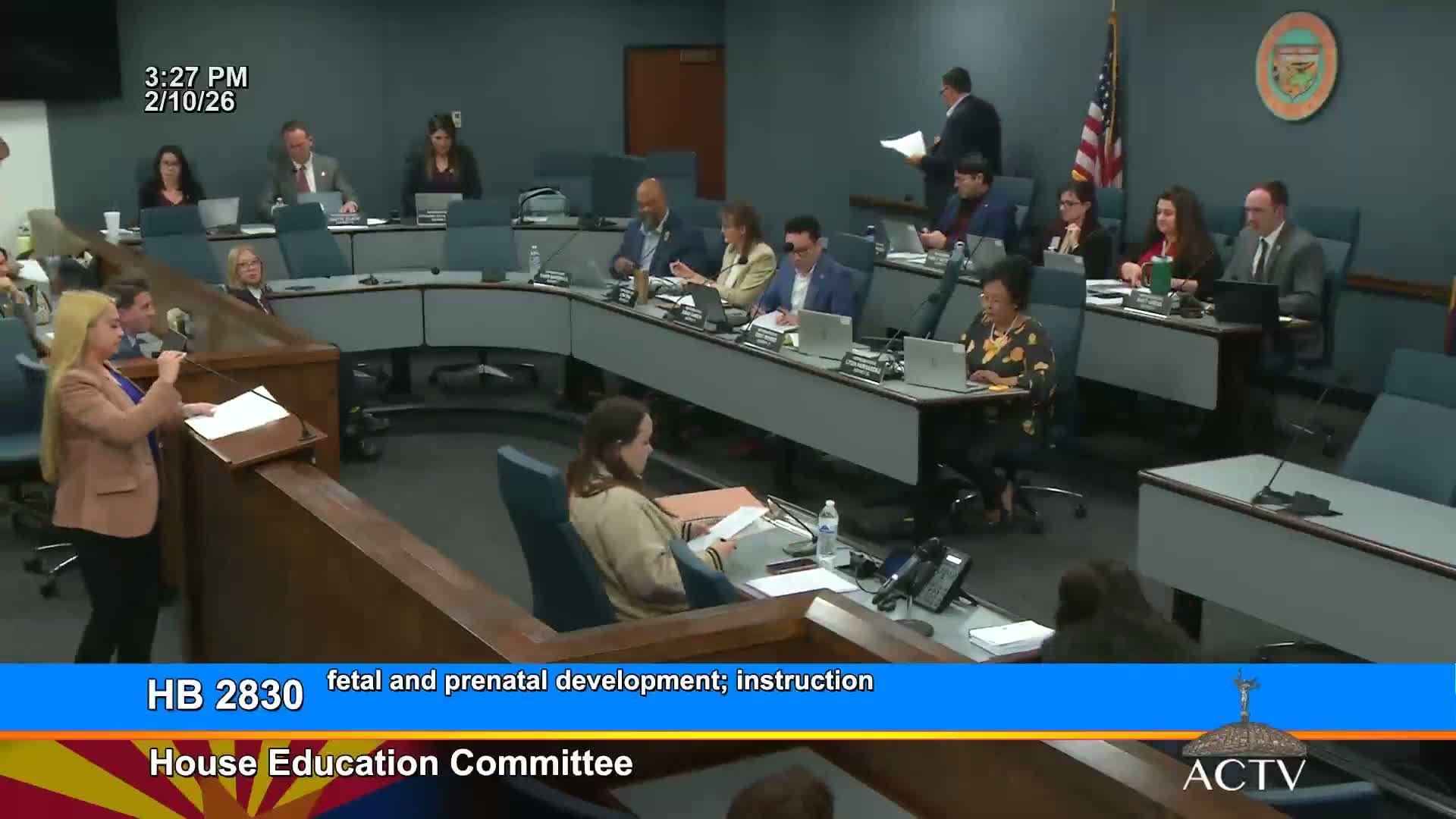
Committee backs bill directing State Board to set fetal and prenatal development standards amid heated debate over scope
Loading...
Summary
HB 28‑30 would require the State Board of Education to adopt science standards requiring instruction on fetal/prenatal human development, specifying grade levels; advocates called it 'science and parental transparency,' while educators and reproductive‑rights groups warned it fragments life‑science instruction and could be used to advance anti‑abortion aims.
Representative Keshel presented House Bill 28‑30 as a science‑based measure that would require the State Board of Education to develop age‑appropriate instruction on fetal and prenatal human development, drawing on existing life‑science standards. “All it does is present science‑based facts to students to show the development of a baby from the time of conception all the way to birth,” Keshel said.
Opponents — including Estelle Blanc of the Arizona Education Association and Jody Leggett of Reproductive Freedom for All Arizona — argued the bill dictates classroom content in statute, undermines local professional judgment and isolates fetal development from broader reproductive and sexual‑health instruction. “This bill creates a fundamental contradiction in science instruction,” Estelle Blanc said, warning it mandates “fragmented science, not education.”
Supporters including Katarina White of Arizona Right to Life and Lake Havasu Unified School District Governing Board President David Rose said parents want factual, age‑appropriate instruction with clear guardrails. Rose said the bill “provides statewide standards, places oversight with the State Board of Education, and allows educators to teach confidently within well defined academic boundaries.”
Committee members repeatedly pressed sponsors and witnesses on how the curriculum would handle student questions about reproduction, how the State Board would determine grade appropriateness, and how the bill differs from comprehensive sex education. The sponsor said the State Board would set age‑appropriate grade levels and that the bill intentionally limits what the instruction may include.
After public testimony from multiple proponents and opponents, the committee gave HB 28‑30 a due‑pass recommendation (vote recorded as 8 ayes, 4 noes).