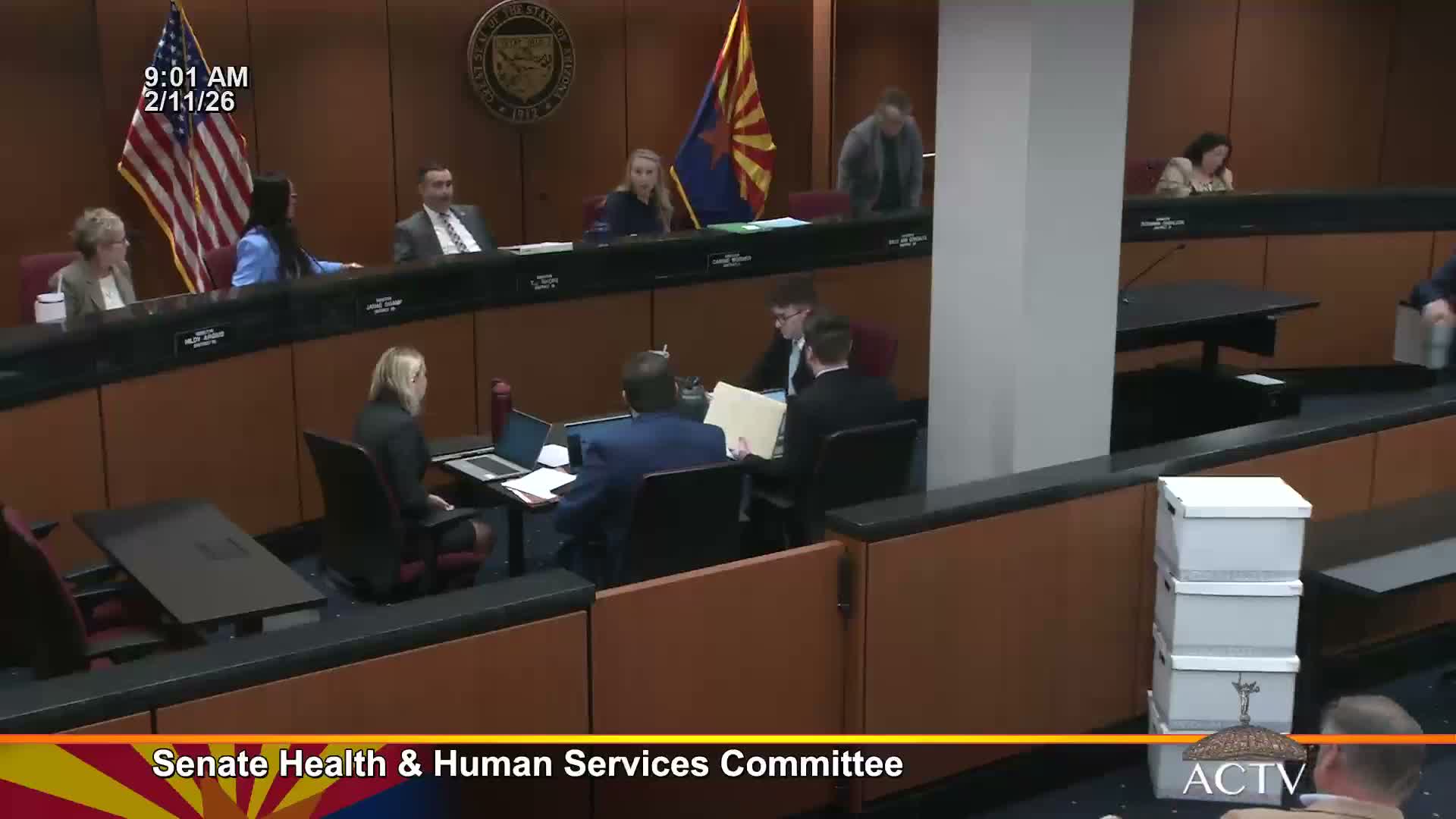
Senate Health Committee advances package of bills to fix AHCCCS payment failures, expand tribal oversight and shore up behavioral-health services
Loading...
Summary
The Arizona Senate Health Committee on Feb. 10 advanced a broad set of health bills aimed at correcting AHCCCS payment problems, expanding oversight of the American Indian Health Program, creating a capped Medicaid-funded long-term services program for people with serious mental illness, and strengthening privacy and claims-timeliness rules for providers.
The Senate Health and Human Services Committee advanced a package of bills on Feb. 10 intended to address a range of problems uncovered during months of oversight of Arizona’s Medicaid administration (ACCESS/AHCCCS). Committee members approved measures dealing with out-of-network reimbursements, tribal oversight of the American Indian Health Program (AIHP), creation of a limited home- and community-based-services program for people with serious mental illness (SMI), privacy for first responders, claims-timeliness standards and medication access for people with SMI.
Chairperson and sponsor-led amendments accompanied several bills after senators and witnesses raised concerns about implementation, federal approvals and tribal consultation timelines. Much of the day’s debate was framed by testimony from tribal leaders, behavioral-health providers and ACCESS representatives about widespread payment delays and historic failures by the agency to detect fraud, which committee members said left Native American patients and community providers harmed.
SB 10-86 (out-of-network lab reimbursements) Sponsor Senator Finsham said SB 10-86 would require AHCCCS contractors to reimburse noncontracting providers for laboratory services when a member is referred by a contracting provider, and would prohibit prior authorization for diagnostic services. The committee adopted a Warner amendment limiting reimbursement so that noncontracting provider payment rates cannot exceed the rates paid to contracting providers. Access’s legislative liaison, Damien Carpenter, said the agency is neutral and warned that removing utilization controls could increase unnecessary testing and fiscal exposure. The committee voted to send SB 10-86, as amended, with a due-pass recommendation (vote: 4 ayes, 2 noes, 1 not voting).
SB 16-11 (AIHP — ASO/MCO contracting and tribal oversight) SB 16-11, described by its sponsor as an emergency measure, would require ACCESS to use an administrative services organization (ASO) or a contracting health plan to perform program integrity and case-management functions for AIHP while preserving ACCESS’s ultimate administrative responsibility. A multi-page chair amendment expanded the ASO’s scope to include provider support and data analytics, clarified that ASO integrity functions do not supersede the Office of Inspector General, added multiple tribal nonvoting observers to procurement oversight, and excluded services delivered by the Indian Health Service (IHS) and tribal facilities from ASO oversight. Tribal leaders testified in conditional support, asking for statutory language to make exemptions and consultation requirements clearer. ACCESS said it is neutral but concerned about compressed federal timelines if the bill’s emergency clause is enacted. The committee passed SB 16-11 as amended (due pass recommendation; vote recorded in committee: 5 ayes, 2 noes).
SB 16-30 (HCBS for SMI — capped pilot) Sponsor Senator Angus presented SB 16-30 as a narrowly capped effort (amendment set the cap to 250 enrollees) requiring ACCESS to seek federal approval to create Medicaid-funded long-term home-and-community-based services for people with SMI who meet a high-acuity eligibility tool. Stakeholders, including family advocates, described long episodes of repeated hospitalizations and homelessness among the target population and urged the committee to approve a pilot with strong fraud-prevention guardrails. ACCESS said it was neutral and that fiscal estimates are pending. The committee adopted the Angus amendment and sent the bill with a due-pass recommendation.
Other bills advanced - SB 11-93 protects emergency medical care technicians’ personal identifying information from commercial public-record requests; amendment clarifies covered data; committee recommended due pass. - SB 13-18 repeals outdated state language about dense-breast notifications so reports align with updated FDA requirements; ADHS supported deferring to federal language; committee recommended due pass. - SB 13-45 would limit anonymous complaints to ADHS/AHCCCS unless the complainant is a witness or the subject; ACCESS warned of potential conflicts with federal rules that require some preliminary investigations; sponsor said the bill preserves anonymity to the agency while requiring a name/phone number on file; committee recommended due pass. - SB 13-46 sets timeliness standards for fee-for-service claims administration (72-hour deficiency notice; 10-business-day adjudication for corrected claims); ACCESS said meeting those new standards would be a major operational change; committee recommended due pass. - SB 14-51 would appropriate $60 million from the state general fund for a 10% rate increase for inpatient and outpatient behavioral-health services; provider groups urged support to stabilize the system; committee recommended due pass. - SB 14-96 contains technical and procedural changes for the Department of Child Safety (DCS) including making DCS able to become an interim representative payee; DCS explained the measures preserve benefits and reduce administrative delay; committee recommended due pass. - SB 16-31 requires that a trained forensic interviewer conduct a forensic interview within 72 hours for alleged child sexual abuse (with narrow exceptions); DCS said OCWI coordinates with law enforcement and advocacy centers and is neutral on the bill’s form; committee recommended due pass. - SB 16-32 gives a DES credentialing applicant 14 days to cure deficiencies and preserves administrative appeal rights; committee recommended due pass. - SB 16-72 would restrict prior authorization and step-therapy requirements for FDA-approved antipsychotics for eligible SMI members, limit step therapy to two prior antipsychotics adjudicated electronically, and allow bypasses based on prior history; patient advocates and a coalition of chronic-care groups urged the committee to reduce barriers to medication access; committee recommended due pass.
What happens next All bills that received a due-pass recommendation will go to the full Senate for consideration. Sponsors and stakeholders signaled willingness to continue negotiating statutory language — particularly on SB 16-11 (tribal consultation and emergency clause language), SB 13-46 (claims-processing operational feasibility), SB 16-30 (eligibility and pilot metrics) and SB 16-72 (scope of commercial-plan coverage and long-acting injectables). Several committee members asked staff to produce fiscal estimates and drafting options before floor debate.
Representative quotes from the hearing "These are all natives that have died ... and it is abhorrent what happened to them," Sponsor (Senator Warner) said while describing the human harm tied to payment and program failures in the AIHP system. "If we don't have [medical necessity] documents, CMS will come down and ask for documents," Damian Carpenter of ACCESS said in explaining federal review risks tied to utilization controls.
Closing note The committee’s actions reflect a multi-part response to years of oversight hearings and stakeholder meetings about AHCCCS operations, tribal concerns and behavioral-health capacity. Sponsors emphasized that many of the bills are intended to be tools to begin fixing problems identified in recent investigations rather than final solutions.