Get Full Government Meeting Transcripts, Videos, & Alerts Forever!
Get email alerts on the Curriculum Review topic
No spam. Unsubscribe anytime.
Committee hears K–12 math and literacy curriculum review; district outlines I Ready, MyPath, Synergy and HMH implementations
Summary
District academic leaders presented K–12 math and literacy curricula, highlighted K–5 use of I Ready and MyPath (30–45 minutes/week recommended), secondary adoption of MidSchool Math and Illustrative Mathematics, transition of end-of-unit assessments to the Synergy Assessment Module and the district’s shift to structured literacy (science of reading).
Portland SD 1J senior curriculum leaders reviewed the district’s K–12 math and English language arts programs at the Teaching, Learning and Enrollment Committee meeting on Feb. 12, outlining core materials, instructional routines, technology use and assessment changes.
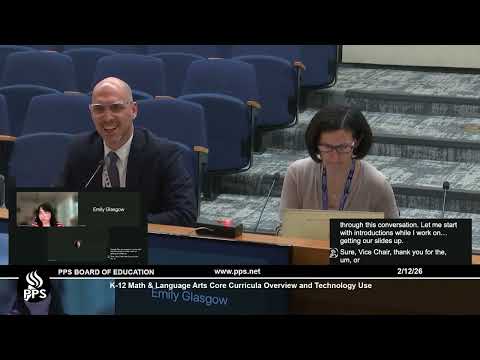
Emily Glasgow, senior director for pre-K–5 academics, described the district’s elementary math adoption, I Ready, as a multi-component program that includes a teacher-focused digital toolbox, student practice worktexts, manipulatives and the MyPath online practice tool. "Students take a diagnostic assessment, 3 times a year," Glasgow said, and MyPath is recommended for "30 to 45 minutes a week" as a supplement to teacher-led instruction. She emphasized multi-day lesson cycles (explore, develop, refine) and discourse-rich classroom routines.
Senior director for secondary academics Filip Christich said the district uses MidSchool Math for middle grades and Illustrative Mathematics in high school, and highlighted professional learning around "building thinking classrooms" that foreground student sense-making before formal instruction. He described the district expectation of daily or weekly math instruction minutes that create space for whole-group, small-group and independent practice.
On literacy, presenters described Portland’s shift from a balanced-literacy model to structured literacy grounded in the science of reading. K–5 materials listed included Heggerty for phonics, Wit & Wisdom for text-based instruction, and Benchmark Adelante for Spanish dual-language classrooms; elementary students typically receive about two hours of dedicated literacy time in early grades and 90 minutes in upper elementary.
Filip Christich announced an assessment change: the district is transitioning end-of-unit and post-milestone assessments from paper to an online platform, the Synergy Assessment Module, beginning with math and language arts. "We are transitioning these assessment assessments from paper and pencil to an online platform called Synergy Assessment Module," he said, adding that the move will allow central staff and principals to access more timely, standards-aligned item-level data.
Committee members pressed presenters on implementation challenges: teacher feedback channels, fidelity monitoring and how students who miss days catch up. Presenters described a districtwide instructional 'look-for' rubric used by principals during instructional walks, teacher toolboxes aligned to lessons, instructional coaching, and intervention programs (Rewards for reading, I Ready for math intervention at middle school) used to support students who lag behind.
Presenters also discussed access to advanced coursework, saying most high schools now offer AP, IB or dual-credit options; Cleveland and Lincoln were cited as IB schools. The presentation closed with a reminder of the state-mandated curriculum review cycle and that districts may opt for mid-cycle updates when materials are revised.
The committee did not take policy action during the meeting; presenters offered to provide data slides and follow-up materials for board members.