Get Full Government Meeting Transcripts, Videos, & Alerts Forever!
Get email alerts on the Housing Affordability topic
No spam. Unsubscribe anytime.
Eastern Shore delegation hears state housing package as Habitat and Diakonia warn of strained supply and shelter capacity
Summary
Secretary Day outlined the state's housing package — including the Starter and Silver Homes Act and Housing Certainty Act — while Habitat for Humanity and Diakonia described local shortages, rising building costs, exhausted rental assistance grants and shelter beds that remain full nightly on the Lower Shore.
State housing policy and local housing needs dominated the latter half of the Eastern Shore delegation meeting on Feb. 13.
Maryland Secretary Day told members the administration is pursuing a three-part approach — supply, stability and subsidy — and highlighted a package of bills this session: the governor's housing package, the Transit and Housing Opportunities Act, the Starter and Silver Homes Act and the Housing Certainty Act. He described regulatory and permitting reforms intended to increase production and cited recent polling and comptroller data showing voters consider housing costs Maryland's top concern. He argued the Starter and Silver Homes Act could unlock roughly 9,300 units annually and said the state is funding a $7 million grant pool to help local governments hire staff or update codes to speed production.
"There is no silver bullet," Secretary Day said, urging a mix of statewide policy floors and local innovation to produce homes. He said the administration has engaged with municipal associations and acknowledged local concerns about preemption, noting amendments have been added to preserve design standards that are not used to effectively deny otherwise-allowed housing.
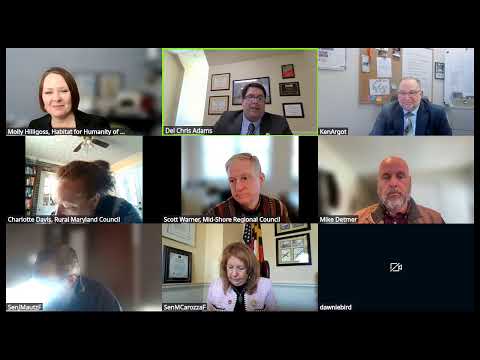
Local housing providers delivered a stark financial picture. Molly Hilligas, CEO of the local Habitat for Humanity affiliates, said the organization used a $450,000 rental and utility assistance grant to serve 171 families but had to deny 460 applications for lack of funds. She said the nonprofit expects to deliver 25 homes across affiliates this year and complete roughly 85 critical repairs, but rising hard costs make building more difficult: "Our hard costs were 198,000 plus the cost of the land, plus the permits," she said, describing deep‑subsidy down‑payment support of $50,000–$80,000 to enable home purchases and urging passage of HB805 (Building Homes Act) to ease nonprofit financing and discourage flipping.
Ken Argett of Diakonia described crisis-level homelessness and shelter strain on the Lower Shore: Diakonia's shelter capacity (about 55 beds, depending on census) is regularly full, outreach teams encountered 381 newly homeless people in the past year versus a Point-in-Time count of 68, and treatment and behavioral-health capacity are limited. Argett described case-management efforts for veterans, shallow subsidies to bridge rent shortfalls and community fundraising that followed state budget commitments; he urged continued state-local collaboration to unlock capital and expedite projects.
Delegates raised concerns about local identity and design standards. Several Eastern Shore members said they fear statewide measures could reduce local control over zoning and community character; Secretary Day responded that the legislation seeks an iterative path and promised continued dialogue and amendments as needed.
Speakers also discussed infrastructure constraints: Secretary Day said the local government infrastructure financing program can fund water/wastewater projects and package plants; Habitat and delegates said EDU and capacity limits, Bay Restoration Fund appropriations and permitting remain practical barriers to more housing production. The session closed with an invitation from presenters to continue meetings with delegates about permitting, funding and targeted local solutions.