
Senate panel backs library-materials bill after amendment to broaden staffing definitions
Get AI-powered insights, summaries, and transcripts
Subscribe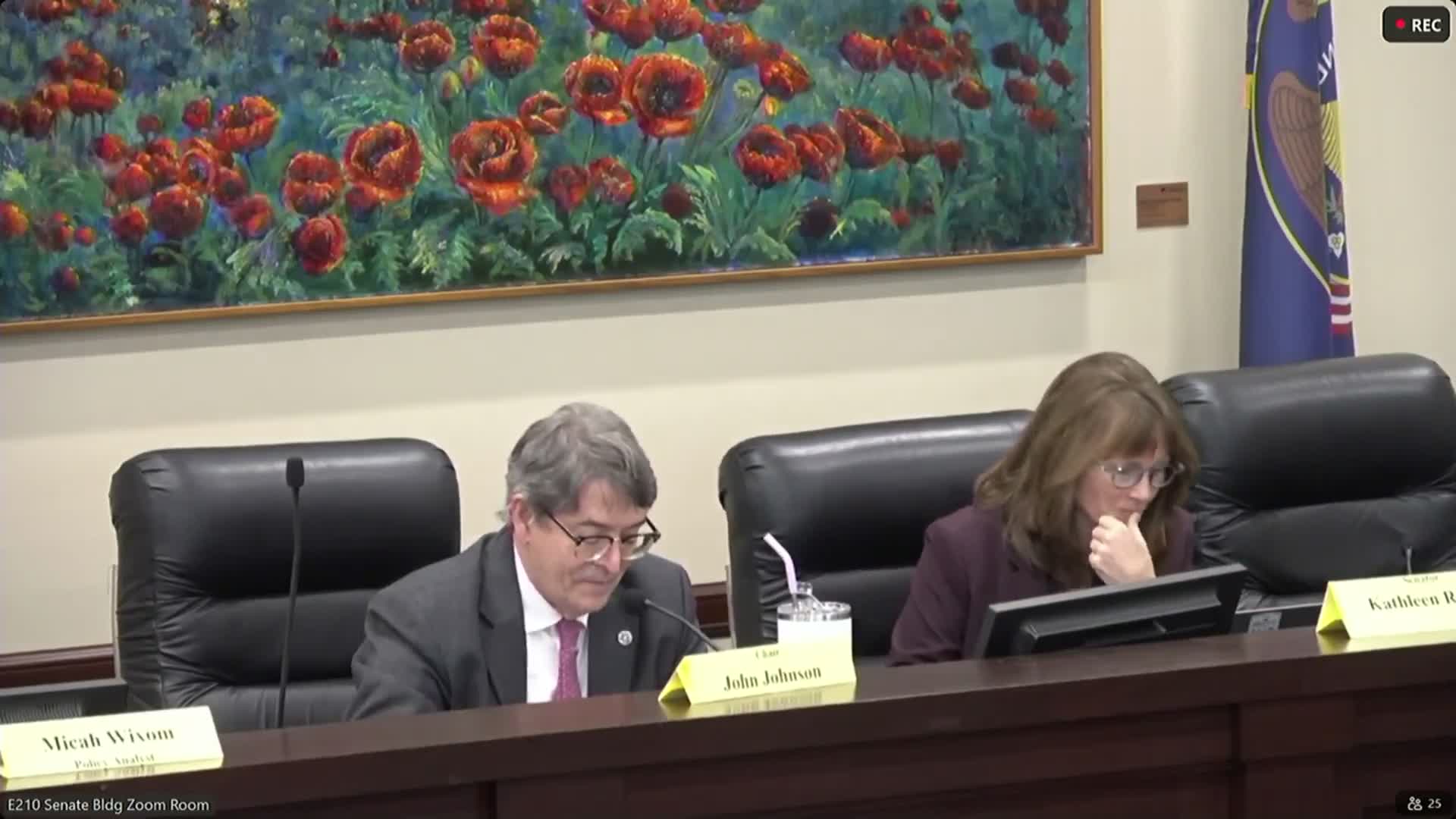
Summary
The Senate Education Committee voted to favorably recommend SB 253, an education bill that requires local library collection policies, a reconsideration process and protections against retaliation; sponsor removed a master's-degree requirement and added certified language-arts teachers to the staffing definition after stakeholder feedback.
The Senate Education Committee on Feb. 12 voted to send Senate Bill 253, as amended, to the full Senate with a favorable recommendation. The bill updates school library policy requirements and clarifies procedures for reviewing and relocating materials from school collections.
Sponsor Senator McKell told the committee that SB 253 “does not override or negate any provision of state law, including prohibition of sensitive materials under section 53g-10-103,” and that the bill deliberately leaves existing sensitive-materials rules intact while adding collection-development and digital-materials policies and a reconsideration process.
The sponsor said the amendment—adopted by the committee—removes a requirement for a certified librarian holding a master’s degree and adds an option for a certified language-arts teacher to meet the staffing standard in some schools. “We had concerns about resources and access to certified librarians in elementary schools,” the sponsor said while explaining the change.
Committee questioning focused on two points: whether the bill could limit principals’ authority to discipline or reassign staff and whether requiring higher credentials would raise costs. The sponsor replied that the bill includes anti-retaliation language (lines 250–258) to prevent LEAs from penalizing employees and that the amendment specifically addressed credential and cost concerns.
Multiple education stakeholders testified in support. The Utah Library Association cited recent audits of school library materials (June and October 2025) and recommended clearer collection policies; EBSCO Information Services told the committee its databases provide tools for local curation and student-privacy protections. Local teachers and school-board representatives said certified library staff improve literacy supports and collection curation.
Senator Baldry moved to hold the bill to allow more time for opposition to present, but that substitute motion failed and the underlying motion to favorably recommend SB 253 as amended passed. The committee recorded no roll-call tally in the transcript for the final recommendation; the chair announced that the motion carried and the bill will proceed to the Senate floor.
Next steps: SB 253 will proceed to second reading on the Senate floor; the sponsor said she will continue to work with stakeholders on clarifying language and implementation details.