Get Full Government Meeting Transcripts, Videos, & Alerts Forever!
Get email alerts on the Budget Priorities topic
No spam. Unsubscribe anytime.
Bloomington council refines 2026 budget priorities; debate centers on council staffing, Jack Hopkins grants and infrastructure
Summary
Council members used a member survey to draft a priorities letter for the administration, emphasizing transparency, infrastructure maintenance, food security, non-police community response teams and council capacity. Members disagreed on specifics such as a $200,000 council-office investment, doubling Jack Hopkins grants, and multi-million-dollar street and sidewalk investments.
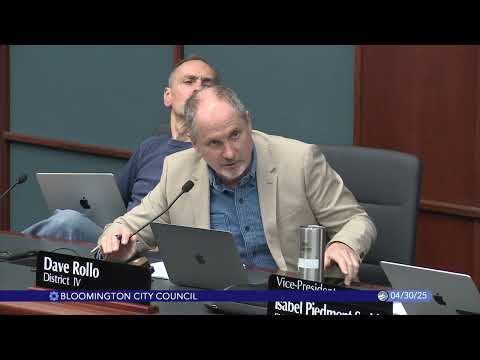
The Bloomington Common Council spent much of its April 30 special session refining a draft priorities letter for the 2026 budget cycle, debating which initiatives to include and whether to attach dollar figures as anchors for negotiations with the administration.
Members said the letter reflects ideas rated in a council survey, with items scoring 3.5 and above incorporated into the draft. Top objectives included incorporating transparency across government, maintaining city infrastructure, increasing food security, creating a non-police community response team, expanding mental-health partnerships, and operationalizing equity.
Points of contention and detail: - Council office capacity: A $200,000 placeholder was proposed to boost council operations (staffing, outside consultants, training), but the city counsel’s draft department budget shared with committee members showed far smaller increases focused on non-salary items. Attorney Lehner told members her draft followed controller guidance to exclude salaries from department submissions; she recommended focusing initial investments on training, support and targeted consultant work while staff studies staffing needs. - Jack Hopkins social-service grants: Some members urged doubling the program (cited in debate as expanding to about $1,000,000 in total), arguing it supports food, housing and immediate needs. Others warned the council lacks administrative capacity and called for clearer outcome metrics and stronger grant-administration systems before expanding the pot. - Transportation and safety: Members discussed a Safe Streets for All investment estimate of roughly $6–10 million and an $8 million ask for sidewalks, multi-use paths and bike lanes, alongside lower-cost safety measures such as bump-outs and leading pedestrian intervals. Several members noted a deferred-maintenance backlog and stressed matching state or federal funds where possible. - Public safety and emergency services: Councilors raised ambulance and EMS staffing concerns and the role of dispatch; discussion of a non-police community response team highlighted the need to scale any pilot and to integrate with dispatch protocols.
Process and next steps: The council did not vote on the letter; members agreed it needs further editing and clearer language before being transmitted. Staff will incorporate edits and aim to present a near-final draft for the May 14 joint session with the administration and in packet materials ahead of upcoming meetings.
Public input: During public comment, speakers urged outcome-based investments and long-term asset upkeep (Greater Bloomington Chamber of Commerce), stronger data-quality governance (a remote commenter), and greater street-safety enforcement after a survivor’s account of a severe bicycle crash.
The council adjourned after setting a short schedule for edits and further committee work.