Get Full Government Meeting Transcripts, Videos, & Alerts Forever!
Get email alerts on the Sb1 topic
No spam. Unsubscribe anytime.
Indiana's SB1 could shrink Bloomington revenue by millions, consultant warns
Summary
A municipal financial consultant told Bloomington City Council that Indiana Senate Bill 1 will change property and local income tax formulas and could reduce city revenues by millions at full implementation, with the county's decision on a 0.4% fire/EMS rate a key variable.
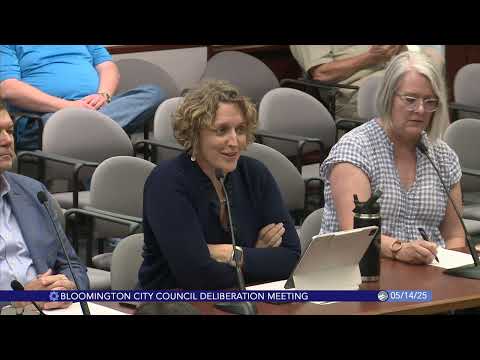
Eric Reedy, president of Reedy Financial Group, told the Bloomington City Council on May 14 that Indiana Senate Bill 1 (also discussed in the meeting as Senate Enrolled Act 1) will materially alter local revenue streams and could reduce the city's revenue base by millions once fully phased in.
"We project that there'll be a $6,000,000 loss tentatively in property tax at full implementation in 2032," Reedy said, and added that the change to local income tax will reduce the city's income tax revenue by about $7,420,000, yielding a combined $13,420,000 reduction in current revenue under the consultant's full-implementation scenario. He said the loss could be largely offset if Monroe County adopts a new 0.4% rate for fire and EMS, which Reedy estimated would produce about $11,660,000 for the city at full implementation; with that offset, Reedy said, the net gap would be roughly $1,850,000.
Comptroller McClellan emphasized the practical importance of the county decision. "The most important leads out of this are the 4% or the point 4% from the county for fire and EMS," she said, noting that the county's choice about that rate will materially change the city's fiscal picture.
Reedy summarized several policy mechanics that create the revenue shifts: a new flat homestead deduction phased in over several years (Reedy described a flat 66.7% homestead deduction when fully implemented), a raised exemption threshold for business personal property (moving from $80,000 to $2,000,000), removal of the 30% floor for assets placed into service after July 1, 2025, and replacement of the existing layered LIT model with a structure that gives cities a 1.2% rate they control while the county controls remaining rates.
He also flagged impacts to tax increment financing (TIF) and debt controls: some business personal property will no longer count in the same way for local units, existing TIF assets are grandfathered from the 30% floor removal, and the new law places limits on short-term debt (defined as five years or less) with a one-year cooling-off period before replacement.
Council members asked detailed clarifying questions about timing, which units receive new credits, and which revenues can be used where. Reedy confirmed the credits are not separately funded by the state and that the credits reduce local tax receipts. He explained that while 2026 effects will be modest, the full phase-in to the law's structure was modeled at a 2031/2032 horizon and that the county's adoption of its 0.4% option is decisive for the city's long-term shortfall.
The presentation concluded with the council requesting further parcel-by-parcel analysis. No vote or formal policy decision on SB1 measures occurred during the meeting; staff and consultants were asked to supply more granular projections for forthcoming budget work.
Bloomington officials said they will continue to engage county partners to understand whether the county will adopt the 0.4% fire/EMS rate and will return with more detailed estimates for the council as budget season progresses.