Get Full Government Meeting Transcripts, Videos, & Alerts Forever!
Get email alerts on the Psap Funding topic
No spam. Unsubscribe anytime.
Monroe County PSAP budget gap, SB 1 changes prompt committee to approve revised grant guidelines
Summary
The Monroe County Public Safety Local Income Tax Council elected Piedmont Smith chair, approved revised application guidelines for one-time emergency needs and discussed how SB 1’s consolidation of local income-tax buckets could leave a $2.78 million PSAP shortfall against a $5.1 million dispatch budget; staff will return with estimates after Aug. 16 certified numbers are released.
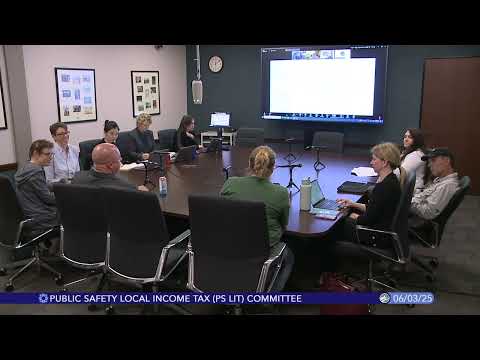
The Monroe County Public Safety Local Income Tax Council elected Piedmont Smith chair and voted to approve revised application and funding guidelines for one-time emergency needs, while members pressed staff for clarity on how the repeal of ‘PS’ and other lit buckets under SB 1 will affect dispatch funding.
Jessica McClellan, the city controller, told the council that PSAP (public-safety) local income-tax distributions for 2025 totaled $2,781,000 and that the dispatch center’s total budget—when county contributions and state E-911 funds are included—was about $5,100,000. “PSAP lit revenue in 2025 is 2,781,000,” McClellan said, and she added that the city has been using reserves in the PSAP fund to cover the portion not covered by certified PSAP distributions.
The nut of the discussion was how the state’s SB 1, which consolidates some local income-tax categories into city and county buckets, will change the mechanics of those distributions starting in 2027 and what that means for existing PSAP reserves. McClellan warned the committee that the 2026 certified PSAP numbers will not be available until Aug. 16 and that staff must estimate probable revenue shares for 2026 in advance of that date.
Committee members repeatedly asked where existing PSAP reserves are recorded and whether reserves for smaller towns that are served by the dispatch center—Ellettsville and Stinesville—have been separately tracked. McClellan said the county’s trust fund balance is in the range of about $2.5 million and that an additional supplemental distribution of $215,685 had been paid to the county and placed in reserves. She described how supplemental distributions arise when county trust funds exceed a given threshold and are then distributed back to local units.
Sarah Taylor, director of civilian operations for Monroe County Central Dispatch, outlined operational needs and staffing: major capital replacements in 2025 included replacement of 22 radio-room consoles and a second UPS, and vacancy rates for supervisor and dispatcher positions remain high. “We are on track with our spending for this year for what we projected from last year,” Taylor said, but she added that personnel costs are likely to rise under the city’s new pay structure and that the dispatch policy board will meet June 26 to review the proposed 2026 budget.
On the committee’s program side, the council reviewed the public application and guidelines for emergency-service providers that are not funded through a city, town or county budget. The rules limit awards to demonstrated, one-time urgent needs—examples historically funded included breathing apparatus (SCBAs), repeaters and MDT/radio upgrades—and members debated whether to include a non-exhaustive example list to help applicants. After discussion, the committee moved to approve the application and guidelines (document revised 06/13/2024) with removal of a paragraph on page 2 and updates to dates and contact information; the motion passed on roll call.
The body set a near-term timeline: applications will be due June 30; staff will use estimated PSAP figures until official 2026 certified numbers are released on Aug. 16; and the committee scheduled follow-up meetings for July 17 at noon and July 28 at 12:30 p.m. to consider applications and the dispatch budget.
Members asked staff to clarify how interlocal agreements and any post-SB 1 governance structure would allocate ongoing dispatch obligations and whether a separate committee or the same participants will oversee post-transition revenue flows. McClellan said the state has not issued guidance on how to handle the transition and that no final decisions have been made. The committee also recommended involving the county auditor in future discussions to help track reserves and distributions.
The meeting closed with thanks to staff and participants; no additional formal actions were taken. The committee expects staff to return with more detailed PSAP revenue estimates and budget implications after the Aug. 16 certification.