Get Full Government Meeting Transcripts, Videos, & Alerts Forever!
Get email alerts on the Pedestrian Infrastructure topic
No spam. Unsubscribe anytime.
Bloomington council reviews sidewalk committee’s role, funding and pedestrian-safety options
Summary
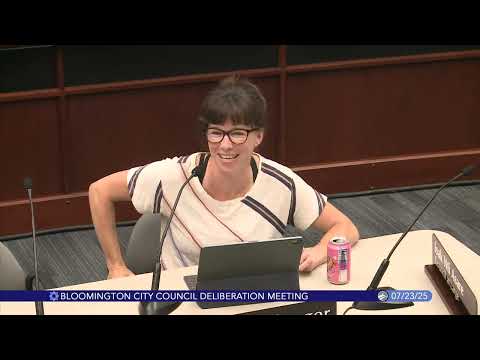
At a July 23 deliberation session the Bloomington Common Council reviewed whether the council’s sidewalk committee should continue, debated broadening its purpose to cover pedestrian infrastructure and safety, and heard staff and a resident urge more use of tools such as pedestrian hybrid (Hawk) signals and MPO leverage.
Bloomington Common Council members on July 23 debated whether to keep the council’s sidewalk committee in its current form, how the committee’s annual allocation should be used, and whether to rebrand it to emphasize broader pedestrian infrastructure and safety.
Council President Strasburg opened the deliberation by laying out three guiding questions for the council: “Should it exist? What is its purpose? And what should it fund?” Staff and council members described how the committee’s pot of money is drawn from the city’s Alternative Transportation Fund (ATF) and is a relatively small, flexible source intended to reduce reliance on automobiles and improve pedestrian access.
“Last year, parking permits generated about $410,000 in revenue,” President Strasburg said, reading controller-provided figures. He said of that amount roughly $269,000 supported parking operations, $200,000 went to engineering and the sidewalk committee received $500,000 this year — a distribution that required a transfer from the general fund.
Hank Duncan, bicycle and pedestrian coordinator and the committee’s staff liaison, framed the work around the city’s safety goal. “The goal is Vision Zero — zero fatalities or severe injuries on city roadways,” Duncan said, and added that the committee should prioritize pedestrian safety, accessibility and efficient use of limited funds by coordinating with larger street projects.
Neil Koper, senior project engineer, described delivery challenges. He said the city’s timeline for spending can vary year-to-year and that unexpected needs (right-of-way, utilities) often arise during design or construction. “The chair of the committee actually can just say, yes — any project that was in the overall list, you can shift funding in between those projects,” Koper said, noting recent procedural changes intended to make the money more adaptable.
Council members agreed on the broad goal of improving pedestrian safety but differed on the committee’s long-term role. Several members, including Council member Rallo, urged the council to pursue larger leveraging opportunities through the Metropolitan Planning Organization (MPO) and to press for a comprehensive sidewalk or pedestrian master plan to guide capital spending. “We should be advocating for the use of MPO funding for pedestrians,” Rallo said.
Other members argued the committee remains a useful accountability mechanism until a multi-year capital plan is in place. Suggestions for renaming included “Pedestrian Infrastructure Committee” or “Pedestrian Safety Committee” to reflect the broader set of tools the city now uses — bump-outs, refuge islands, rapid flashing beacons and pedestrian hybrid beacons (commonly called Hawk signals).
Council members asked staff about Hawk signals’ cost and applicability. Staff said equipment and installation costs vary with site conditions but offered a rough equipment-only estimate of about $100,000 for a pedestrian hybrid beacon and somewhat less for a rectangular rapid-flashing beacon, with final costs depending on required concrete work, signalization and utility relocations.
A resident, Paul Russo, told the council he was struck by a car last summer and urged increased crossings and enforcement. “I usually get around by bicycle,” Russo said. “I was hit by a car last summer… I strongly support the Hawk system…and more enforcement for speed limits.”
No formal vote or ordinance was taken at the session. Council members directed staff to provide more information on leveraged funding (MPO) and timing options so the committee can better coordinate with repaving and capital projects, and they discussed bringing the committee structure and naming into upcoming committee-resolution work.
The council adjourned with the matter left for further staff follow-up and potential action during the 2026 budget and committee-resolution process.