Get Full Government Meeting Transcripts, Videos, & Alerts Forever!
Get email alerts on the Housing Policy topic
No spam. Unsubscribe anytime.
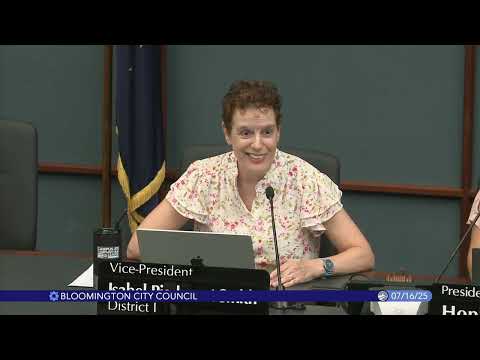
Council hears consolidated plan, advances UDO changes on AMI and single‑room occupancy
Summary
City staff presented Bloomington's 2025–2029 consolidated plan identifying affordability, preservation and services as priorities; council adopted two resolutions to restart UDO amendments on affordability incentives (AMI) and to re‑initiate consideration of single‑room occupancy buildings, forwarding both to the plan commission.
City housing staff presented Bloomington’s 2025–2029 consolidated plan and the 2025 annual action plan, laying out HUD requirements and local priorities for addressing affordability, preserving existing units, and expanding services for vulnerable populations.
Anna Killian Hansen, director of Housing & Neighborhood Development, summarized outreach findings — including long Housing Choice Voucher wait lists (987 on the HCV wait list; 2,168 on project‑based voucher lists), barriers to building or preserving affordable housing (land scarcity, high construction costs, zoning constraints, and short‑term rental pressure), and priority needs identified by stakeholders such as senior services, homelessness prevention, and tenant‑based rental assistance.
After the presentation council members asked about data gaps (occupancy and vacancy rates, short‑term rental counts) and potential regulatory options. Hansen said the department is exploring whether local regulation could require occupancy reporting and acknowledged difficulties in getting voluntary reporting from some multifamily operators.
Separately, the council introduced and adopted two UDO‑related resolutions. Resolution 2025‑10, sponsored by Council member Stossberg, reinitiates a prior proposal to amend UDO text on affordability incentives and AMI thresholds and will be forwarded to planning staff and the plan commission for statutorily required review. Resolution 2025‑11, sponsored by Council member Piedmont Smith, restates a prior proposal to add single‑room‑occupancy (SRO) residential buildings as a permitted use; the sponsor and other council members said plan commission received public input and will continue work (with a plan commission continuance set for August 11).
Public comment during the consolidated‑plan hearing included testimony from Sarah Owen of Exodus Refugee Immigration, who urged the council to prepare for federal cuts that would affect refugees’ access to SNAP and Medicaid, and Joe Davis and others who raised neighborhood concerns about SROs and protections against predatory conversions.
Next steps: Planning and transportation staff and the plan commission will conduct the UDO text‑amendment process and public hearings, with expected follow‑up at council after plan commission recommendations.