Get Full Government Meeting Transcripts, Videos, & Alerts Forever!
Get email alerts on the Affordable Housing topic
No spam. Unsubscribe anytime.
Council approves two PILOT agreements to renovate and preserve affordable housing
Summary
The Bloomington Common Council adopted two payment-in-lieu-of-taxes (PILOT) agreements with the Jean B. Glick Company to fund renovations at Henderson Court (151 units) and Cambridge Square (153 units). Both require long-term affordability and shift tax revenue to a city affordable housing fund.
The Bloomington Common Council on June 4 approved two PILOT (payment in lieu of taxes) agreements aimed at renovating and preserving a total of about 304 affordable units in the city.
Council approved Ordinance 2025-22 for Henderson Court, a 151-unit property at 2475 S. Winslow Court, and Ordinance 2025-21 for Cambridge Square, a 153-unit community serving residents 62 and older or those who are differently abled. Under the proposed agreements the developer would pay a fixed share of property tax liability to the city rather than the full statutory tax; the pilot payments are set at 45% of current tax liability with a 3% annual escalator and run for 17 years. Affordability terms for both projects are at least 45 years.
Jane Cooper Smith, director of Economic and Sustainable Development, said the PILOTs are “a trade off of community goods” — diverting some tax revenue away from other local units in exchange for permanently preserving and upgrading affordable housing. Henderson Court’s initial annual PILOT payment is $80,400 (roughly $935 per unit annually) while Cambridge Square’s payment is $29,376 (about $192 per unit annually).
Janine Betsy of the Jean B. Glick Company told the council the PILOTs are needed to complete each project’s financing and to expand the scope of renovations. “We added HVAC, new electrical panels, in-unit washers and dryers and the funding supports an on-site service coordinator,” Betsy said, describing measures intended to improve resident safety, health and stability.
Council members pressed staff on fiscal impacts to other taxing units. Controller McClellan explained the PILOT tables present conservative, static estimates of foregone revenue; assessed values can rise and the developer could reap greater savings in the future, but the city uses the stated figures as a baseline for financing.
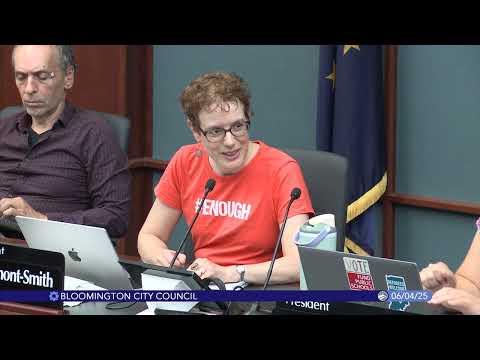
President Stosberg recused herself from the Cambridge Square debate because a family member lives there; Vice President Pete Mottsmith presided. Council approved Henderson Court without dissent and adopted the Cambridge Square ordinance by an 8–0 vote with one recusal. Staff said the pilot payments would first be payable in 2027 (for the 2026 assessment year) after project financing closes.
The PILOT payments will be deposited into the city’s affordable housing fund and are explicitly intended to support renovation, long-term affordability and services for lower-income residents. The council also required that each agreement include extended-use affordability covenants per state law.