
Lancaster officials credit hybrid police model and new technology for steep crime declines
Get AI-powered insights, summaries, and transcripts
Subscribe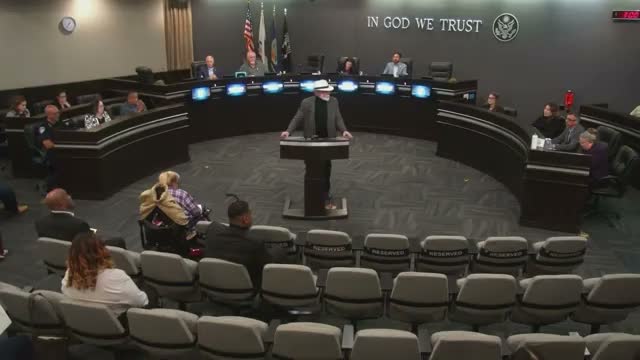
Summary
City leaders and law enforcement credited Lancaster’s hybrid police–sheriff partnership, expanded cameras, drone response and a newly awarded $2 million violence-intervention grant for reductions in several crime categories, including a reported 15% drop in Part I crimes.
Lancaster, CA — City leaders and law enforcement on the Lancaster City Council dais on Monday described a roughly yearlong operation that the city says has driven down several categories of crime by combining a newly created Lancaster police force with expanded sheriff’s resources and new technology.
Mayor R. Rex Paris told the council the city pursued a hybrid police model to supplement, not replace, the Los Angeles County Sheriff’s resources after a decade of what he described as slow county response. "We now have the Lancaster Police Department with very experienced officers," Paris said, noting the city hired officers with significant patrol backgrounds and installed street technologies the city had wanted for years. "Crime has dropped 15%."
The mayor credited executive decisions to pursue local capacity and new tools with improving public safety outcomes. He also said Lancaster recorded a "100% solve rate of the homicides" in 2023 — a claim made in the hearing and reported here as stated by the mayor.
"We're bringing the resources to bear to shut these illegal locations down," said Rod, a city police leader who briefed the council on operations. Rod described specialized teams — a special enforcement unit, motor officers, traffic enforcement and an intelligence/crime center — and said the city had taken action against 96 illicit indoor marijuana grows, 36 illegal smoke shops and 12 unlicensed care homes. He also announced that the city’s core team was one of three entities in the county to receive a California Community Violence Intervention and Prevention award for $2,000,000 to expand intervention programs and youth activities.
A captain at Lancaster Station, speaking for the sheriff’s department partnership, highlighted statistics he said reflected the combined effort: a 15% reduction in Part I crimes, an almost 40% decline in auto thefts, a 37% drop in thefts from vehicles, a 56% decline in gang-related shootings and other decreases. He attributed results to joint operations, technology (including more than 500 cameras and ShotSpotter), the use of drones as rapid-response platforms and the city's decision to fund a Landcap (community appreciation) team that supports targeted enforcement.
Council members and audience members asked technical and operational questions about integrating ShotSpotter alerts with license-plate readers, drone lift-off points and neighborhood participation. Law enforcement encouraged residents to attend the city’s Criminal Justice Commission meetings and to report crimes; they also promoted neighborhood watch and community engagement as complements to enforcement.
The presentation emphasized both enforcement and outreach. Rod described contracting with intervention partners for school and youth programs and said the $2 million grant will help fund intervention and violence-prevention efforts and a youth activities league officer. The sheriff’s captain described recoveries and seizures supporting prosecutions, including firearms and narcotics, and credited technology and community reporting for helping investigators.
What’s next: council members asked staff and law enforcement to continue reporting statistics at commission meetings and to provide details on technology integration and privacy protections. The council did not adopt new ordinances during the presentation; the briefing concluded and the meeting proceeded to other agenda items.