Get Full Government Meeting Transcripts, Videos, & Alerts Forever!
Get email alerts on the House Bill 19 topic
No spam. Unsubscribe anytime.
TRW advances corner‑crossing bill after months of debate; committee narrows language to foot travel and 'physically contacting'
Summary
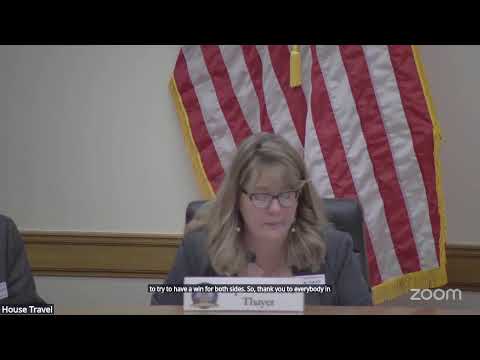
House Bill 19, which would tell law enforcement not to prosecute certain corner‑crossing between adjacent public parcels, passed out of TRW after the committee added narrowing amendments: limiting the exemption to travel by foot, including 'land or property' and adding 'without physically contacting or causing damage.' The bill passed the committee 7–1 (1 excused) after extensive public comment from hunters, landowners and industry groups.
After extensive public comment from hunters, landowners and conservation groups, the House TRW committee voted to advance House Bill 19 with multiple narrowing amendments. The bill, presented by Representative Provenza and explained in detail by attorney Brian Simrad, intends to mirror the Tenth Circuit fact pattern and tell law enforcement that when a person travels between two adjacent public parcels at their corner without physically contacting or causing damage to private property, that conduct should not be treated as criminal trespass under Title 6 or Title 23.
"If the person is traveling from one parcel of land ... to another parcel of land ... authorized to access ... at the corner where the two parcels meet and without causing damage to any privately owned land adjacent to the two parcels, that person doesn't commit a crime," Simrad summarized while reading the bill's operative text. He emphasized the draft is a law‑enforcement clarification that seeks to reduce wasted enforcement and court resources in clear fact patterns rather than to alter property ownership.
Committee members and the public debated several points: whether to limit the exception to travel "by foot or pack animal" (Representative Provenza proposed narrowing language to help hunters and to improve passage), whether state trust lands should be treated the same as federal public lands, how to define "damage," and the challenges of unmarked corners and GPS accuracy. Supporters — hunters, trappers, surveyors and outdoor groups — argued the bill would remove uncertainty and preserve public access; opponents — ranchers, the Farm Bureau and stock grower groups — warned it could erode private property rights and asked that the bill be limited to federal lands or clarified to avoid unintended expansion.
In committee work session the body adopted three main amendments: (1) changing "travels" to "travels by foot" (intended to exclude motorized vehicles and narrow scope), (2) inserting "or property" after "privately owned land" to encompass fences and physical features, and (3) adding "without physically contacting or causing damage" to mirror judicial language. After debate the clerk announced the final roll call tally: 7 ayes, 1 no, 1 excused. The committee passed HB19 as amended and adjourned. The bill will next face floor scheduling and further committee consideration in the Senate if it advances.