
Committee debates SB 40 amendment to VCEA as environmental groups and utilities clash
Get AI-powered insights, summaries, and transcripts
Subscribe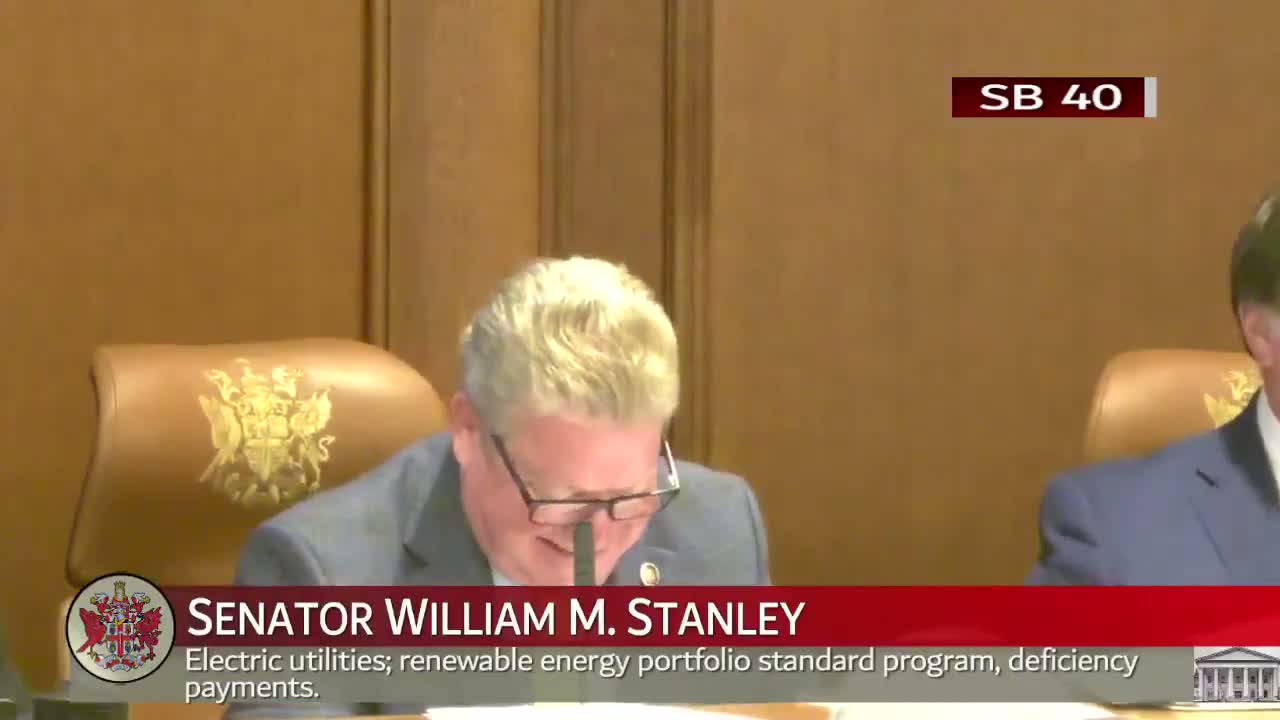
Summary
Senate Bill 40, a substitute that would change how deficiency payments and penalties under the Virginia Clean Economy Act are applied to large commercial customers, drew sharp opposition from environmental groups and some utility critics who warned weakening penalties could erode compliance and long‑term clean energy goals. Sponsors said the changes would reduce immediate costs for ratepayers and provide flexibility to utilities facing supply‑chain constraints.
Senate Bill 40, presented as a substitute, would amend portions of the Virginia Clean Economy Act to expand options for large commercial and industrial customers and reduce or remove deficiency‑payment penalties that can be passed through to ratepayers. Sponsor testimony framed the measure as an affordability step to avoid passing short‑term penalty costs on to consumers and to allow utilities flexibility to focus on long‑term investments in renewable generation rather than immediate financial penalties.
Environmental groups and conservation organizations testified in opposition. Josephus Alman for the Southern Environmental Law Center, representatives from the Virginia League of Conservation Voters, NRDC, the Virginia Conservation Network, and Sierra Club’s Virginia chapter warned that weakening deficiency payments or removing enforcement mechanisms would reduce utilities’ incentives to build the clean energy resources the VCEA requires. Several witnesses said the current implementation path — including upcoming offshore wind and other projects — reduces the near‑term risk of deficiency payments, and that penalties remain an important compliance tool.
Members questioned State Corporation Commission (SCC) staff on projected deficiency payments, the role of REC markets and the Coastal Virginia Offshore Wind project’s (CVOW) expected in‑state generation contribution. SCC testimony indicated uncertainty about long‑range deficiency payment estimates and emphasized multiple moving parts (e.g., project online dates, REC prices and how much energy new projects can deliver in early years).
Committee action: The substitute was adopted and taken up for debate, with a full range of stakeholders offering testimony. The committee recorded motions and roll‑call activity on the substitute; further procedural steps were taken on related bills addressing grid utilization, site assessments, and cost allocation. The transcript records extended questioning and requests for additional SCC data.
What happens next: The fate of SB 40 will depend on further floor action and any technical amendments addressing the concerns of environmental groups and SCC staff clarifications. The committee indicated interest in balancing affordability concerns and long‑term compliance with VCEA objectives.
Sources: Committee testimony from sponsor, SCC staff, environmental NGOs and utilities.