Get Full Government Meeting Transcripts, Videos, & Alerts Forever!
Get email alerts on the Committee Roundup topic
No spam. Unsubscribe anytime.
Senate subcommittees advance dozens of bills; cannabis substitute and PFAS testing draw debate
Summary
Senate subcommittees on Health & Human Resources and Resources reported or carried over dozens of bills. A high-profile committee substitute for SB 542 (cannabis) — preserving a 17% tax and a $15 million conversion fee — passed amid questions about medical providers; SB 386 (PFAS/sewage sludge) drew concerns about major local cost impacts.
The Senate met in committee session in Richmond on Feb. 10 to hear Health & Human Resources and Resources subcommittee reports and to act on dozens of Senate bills, advancing many measures with substitutes and carrying others over for further work. Committee members approved substitutes and reported bills on topics ranging from newborn screening and nursing scholarships to energy assistance pilots and tribal consultation provisions.
A central focus in the Resources package was SB 542 (Sen. Ayers), the committee substitute for broader cannabis regulation and taxation. Staff described the substitute as incorporating SB 826, removing certain courts committee penalties, adjusting licensing and labeling requirements, and retaining a 17% tax rate, a $15,000,000 conversion fee for retail licenses, and distribution of revenue with 40% to early childhood programs and 30% to a cannabis equity reinvestment fund. Staff member Katie summarized the substitute: “no later than 01/01/2028, CCA will become a division of a combined agency at the Alcoholic Beverage Control Authority,” and said the agencies will develop an implementation plan by November. (Speaker attribution per committee record.)
Sen. Evan pressed staff on whether existing medical processors would effectively lose medical access if they declined to pay the $15,000,000 conversion fee for retail operations. Evan said, “I would hate for the medical patients not to be served by people who’ve been meeting this need for years, if they didn’t wanna do the $15,000,000.” Staff replied that medical companies could obtain separate licenses (for example via a separate LLC) and that the office would conduct additional due diligence as the bill advances. The substitute was adopted and later reported out on an electronic vote, recorded as Aye 7, Noes 5, 3 abstentions.
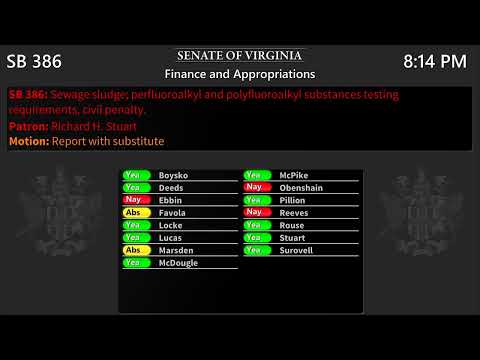
Environmental and infrastructure concerns dominated discussion on SB 386 (Sen. Stewart) about sewage sludge and PFAS testing. Sen. Evan warned of steep costs to localities if treatment or disposal requirements change, citing local projects and estimates: “we're currently constructing a $355,000,000 biosolids thermal dryer” and regional incinerators could cost “between 650,000,000 and 1000000000 dollars” with timelines into the 2030s, creating potential ratepayer impacts and equity concerns. Committee members acknowledged the technical and regional nature of the problem, referenced multistate coordination (including a Chesapeake Bay Commission priority), and adopted a committee substitute that removed some enactment clauses while continuing work; the bill was reported with substitutes (electronically recorded: Eyes 10, No 3, 2 abstentions).
Other committee actions included reporting SB 374 (adding Gaucher disease to newborn screening) with a substitute (roll-call 13–0); reporting SB 405 (transfer of certain nursing scholarship administration to the Virginia Health Workforce Development Authority) (15–0); adopting a substitute and reporting SB 813 (sickle cell access network) (15–0); and advancing bills on paid family leave, paid sick leave, energy assistance pilots, housing trust fund changes, and several other measures. Several bills were carried over for budget consideration or further drafting.
What happens next: the committee reported many bills to the full Senate or continued them for additional consideration or budget action; items with significant technical or fiscal concerns (notably SB 542 and SB 386) were flagged for further review as they move through the legislative process.