Building Code Council legislative committee raises concerns about bills that could change energy‑code scope and override local review

State Building Code Council legislative committee · February 12, 2026

Get AI-powered insights, summaries, and transcripts

Subscribe
AI-Generated Content: All content on this page was generated by AI to highlight key points from the meeting. For complete details and context, we recommend watching the full video. so we can fix them.

Summary

Members of the State Building Code Council’s legislative committee on Feb. 12 discussed pending bills (including HB 2381 and ESSB 5552) that they said could shift energy‑code authority, require acceptance of third‑party certifications by local jurisdictions, and import IECC Section R406 in ways that lower residential energy standards.

OLYMPIA — Members of the State Building Code Council’s legislative committee met Feb. 12 and spent the meeting reviewing the status of several bills and flagging provisions they say could alter the boundary between the state building code and the state energy code.

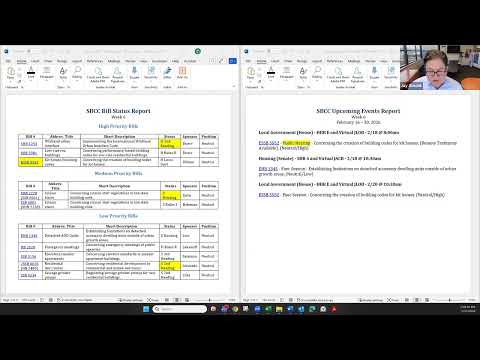
During the committee’s legislative update, staff noted the fiscal cutoff had passed and many bills that did not advance out of policy or fiscal committees were now categorized as dead. Several bills remain active, including ESSB 5552 (a building codes bill now in the House Local Government Committee) and HB 2381, which committee members discussed at length.

Why it matters: Council members cautioned that language in the substitute version of HB 2381 — particularly a Section 3 that references 19.27 and 19.27a — could change how energy‑code compliance pathways are set and potentially permit tradeoffs between embodied carbon and operational carbon across building sizes. Kjell Anderson warned that, as written, the bill “would create a really low bar and move our energy code progress backwards for all residential projects that it applies to.”

Key concerns raised

- Scope and unintended consequences: Anderson said the bill appears to expand the energy code’s scope beyond what he believes was intended by allowing performance‑based compliance that could apply to any building size. He also said the bill’s wording does not resolve how those provisions would interact with an existing statutory requirement for a 70% energy‑use reduction that appears elsewhere in state law.

- Third‑party certifications and local authority: Angela Haupt warned that the substitute language would require the State Building Code Council to create a mandatory appendix and would deem certain third‑party "housing system or plan" certifications to demonstrate compliance with the State Building Code. "They are automatically stamped and deemed complete, and the local jurisdiction just has to deal with it," Haupt said, arguing that the language would strip local authorities of the ability to re‑review or reinspect certified systems.

- Adoption of IECC R406 and ERI pathway differences: Committee members talked about a provision directing the council to adopt Section R406 of the International Energy Conservation Code (IECC). Kjell Anderson and others cautioned that the IECC version of R406 would import a different ERI/HERS pathway that is less stringent than the Washington‑adapted ERI path the council has previously developed, a change Anderson said could lower performance thresholds.

Responses and next steps

Todd Byeruther and other members said they expected the substitute Section 3 language to be removed or amended before the bill reaches the floor. "The expectation is that it will not be in there when it comes back," Byeruther said. Committee members agreed to monitor the bills closely and to provide advice to the legislature if the council determines provisions would produce unintended effects on code authority or performance outcomes.

Formal committee actions and process notes

The committee approved the meeting agenda and the minutes from its Feb. 5 meeting by voice vote. No formal votes on the discussed bills were taken; members limited the meeting to review and discussion. With no further business, the committee moved to adjourn.

What’s next: Committee staff said they will continue tracking HB 2381, ESSB 5552 and other bills, watching for amendments that could address the concerns raised. Several committee members indicated they would inform legislative staff and stakeholders if they identify statutory wording that could be clarified or changed before floor action.