Get Full Government Meeting Transcripts, Videos, & Alerts Forever!
Get email alerts on the Burnt Store Capacity topic
No spam. Unsubscribe anytime.
County told Burnt Store plant could hit capacity in Feb. 2026; staff recommends package MBRs to buy time
Summary
Kimley‑Horn presented projections showing Burnt Store Water Reclamation Facility could meet permitted capacity (~500,000 gpd) by February 2026. Consultants recommended renting or buying packaged membrane bioreactor units to add temporary capacity while a permanent 1.0 MGD expansion is designed and built; commissioners asked for GMP pricing and timing.
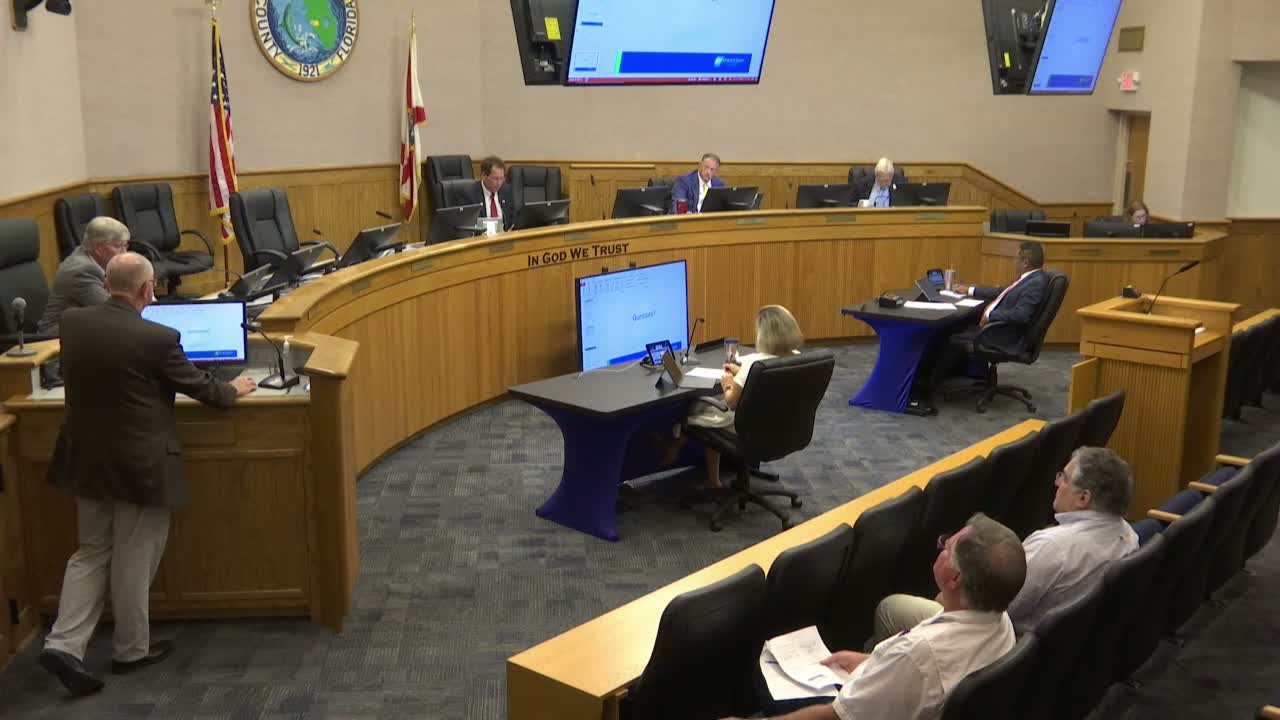
Consultants advised Charlotte County commissioners on July 15 that the Burnt Store Water Reclamation Facility is likely to reach permitted capacity within months and proposed temporary packaged membrane systems to avoid capacity shortfalls while a permanent expansion proceeds.
Louis Bryant of Kimley‑Horn said the plant’s permitted capacity is 500,000 gallons per day and current flows are roughly 465,000 gpd. "We expect to exceed capacity or meet capacity February 26," he told the board, and he recommended a phased plan of packaged membrane bioreactor units (two vendor options discussed) that could provide three to four years of additional capacity if four units were deployed.
Bryant said staff favor the membrane‑based packaged option because of availability, staff familiarity with membrane maintenance, and the systems’ effluent quality. He described two manufacturers (one with immediate availability and another with longer lead time), a rent‑vs‑buy cost comparison and the need to work with the CMAR (Seymour) to develop a guaranteed maximum price and site‑specific piping/integration work.
Commissioners asked about purchase versus rental economics, compatibility with the planned permanent 1.0 MGD expansion, and when the county would need to ‘pull the trigger’ to meet the February timeline. Staff and consultants said they hoped to bring price/GMP information back in September so the board could act in time for the projected early‑2026 capacity milestone.
Next steps: consultants and the CMAR will refine costs and schedule, and staff will return with a recommendation at the September board meeting. The board did not make a binding procurement decision on July 15 but directed staff to return with more detailed pricing and integration plans.