Get Full Government Meeting Transcripts, Videos, & Alerts Forever!
Get email alerts on the Millage Reserves topic
No spam. Unsubscribe anytime.
Commissioners consider millage reductions, propose $25M disaster retention amid $95M FEMA uncertainty
Summary
During the workshop, staff recommended millage reductions for the capital projects and lighting funds and proposed a $25 million transfer to create a risk‑management disaster retention for non‑reimbursable storm costs; commissioners debated using reserves to lower general‑fund millage versus preserving fiscal stabilization amid outstanding FEMA reimbursements.
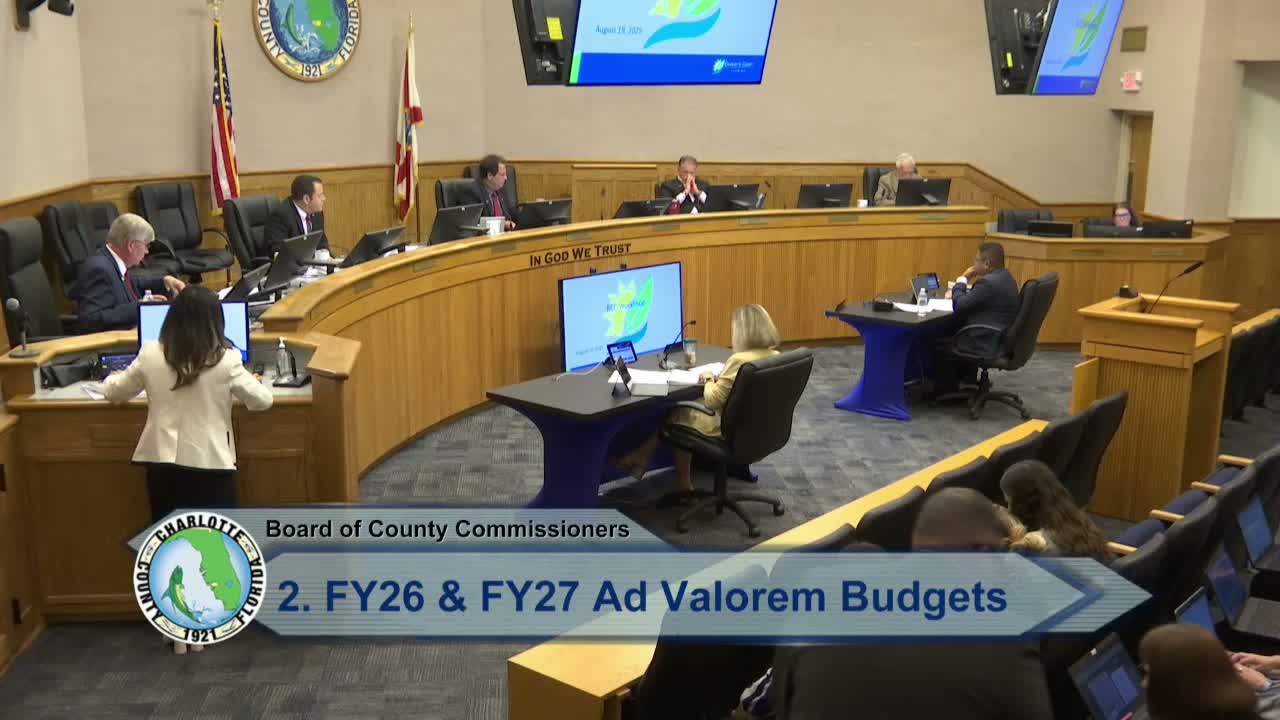
Charlotte County Commissioners reviewed ad valorem millage options and a staff proposal to create a designated disaster retention within the risk management reserve at an Aug. 19 budget workshop.
Francine Lisby, assistant budget director, said staff will present millage reduction options at the Sept. 4 public hearing. She proposed reducing the capital projects millage to the Department of Revenue rollback rate to preserve prior‑year revenue and recommended a 25% reduction to the street lighting millage (to 0.1907), citing a healthy lighting fund balance and LED‑conversion costs that spike expenditures in FY26 but should stabilize.
Lisby and Gordon Berger, Director of Budget and Administrative Services, recommended adding a retention category to risk management "for disaster related costs, but out of pocket costs, so items that we know are not reimbursable," and asked the board to support transferring $25,000,000 from ad valorem reserves into that restricted retention. "It's our recommendation that we move... $25,000,000 from ad valorem reserves to our risk management reserves," Lisby said.
Berger warned the board that using reserves to lower recurring millage is not a one‑time solution because it compounds future reserve reductions. He said the county has paid roughly $226 million for the last five storms and received about $113 million in reimbursements so far; the county is awaiting approximately $95 million in additional FEMA reimbursement. "Use of reserves is not a 1 time thing... if we reduce the millage, you're compounding that loss in reserves by $3,000,000 every year," Berger said.
Commissioner Doherty proposed a targeted, roughly $3 million reduction to the general‑fund millage for the coming year, funded from fiscal stabilization reserves, arguing it would provide short‑term relief for residents. Several commissioners supported discussing that option further, but many urged caution — particularly until hurricane season ends and the state legislative session clarifies property‑tax reform prospects. Some commissioners stressed that lowering millage now could force difficult increases or cuts later if projected reimbursements or revenues do not materialize.
The board directed staff to bring refined millage scenarios and the reserve transfer plan back for the Sept. 4 tentative/final hearing, and asked administration to show the contract and timing implications for projects where staff proposed deferral or phasing. No final millage reductions or transfers were adopted at the workshop.
Next procedural steps include public hearings on Sept. 4 and Sept. 20 where the board will adopt final millage and assessment rates.