Get Full Government Meeting Transcripts, Videos, & Alerts Forever!
Get email alerts on the Rezoning Pd Hutton Capehaze topic
No spam. Unsubscribe anytime.
Charlotte County planning board recommends approval of two rezoning requests despite neighbor opposition over wetlands, flooding and traffic
Summary
After hours of testimony from residents and experts, the Charlotte County Planning and Zoning Board voted to forward two related plan‑amendment/rezoning applications to the Board of County Commissioners with recommendations of approval, citing enhanced PD conditions; neighbors warned wetlands, runoff and traffic would be harmed.
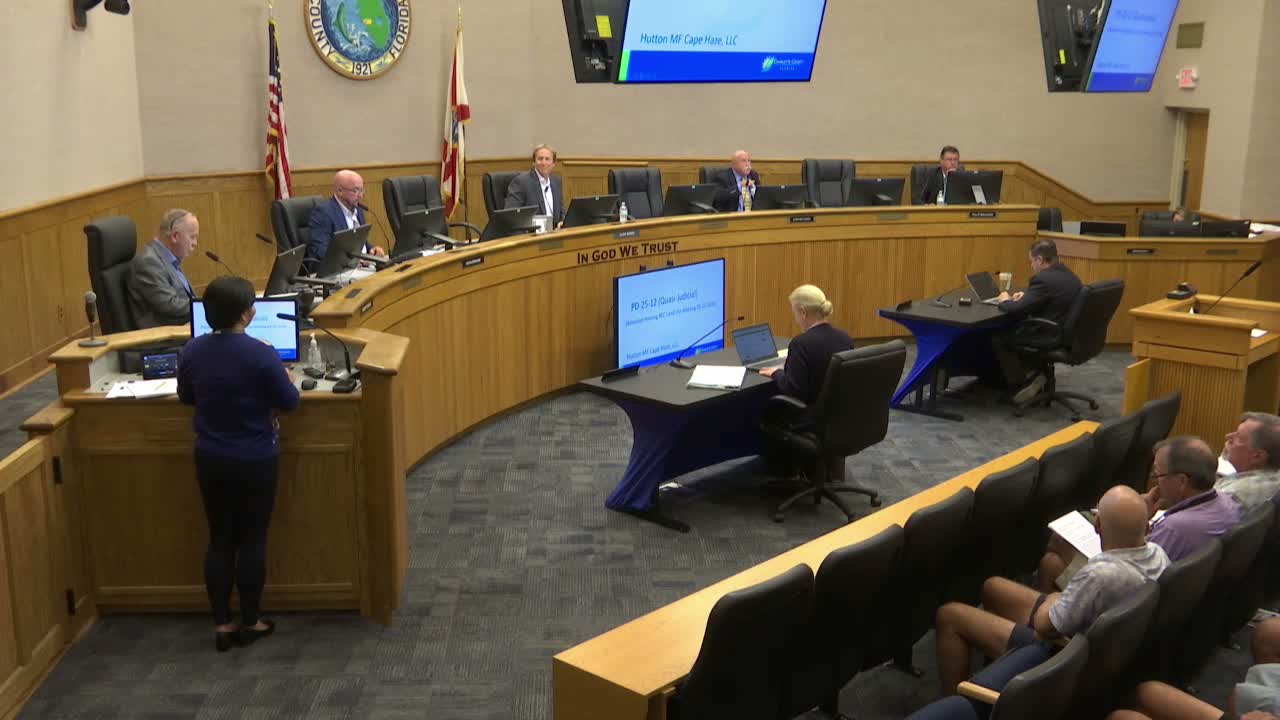
The Charlotte County Planning and Zoning Board on Jan. 30 voted to forward two related land‑use applications — a small‑scale plan amendment (PAS‑25‑03) and a planned‑development rezoning (PD‑25‑16) — to the Board of County Commissioners with recommendations of approval, and separately recommended approval for a contested PD rezoning (PD‑25‑12) after extended public comment and technical testimony.
The votes followed staff presentations that described the proposals as expansions of previously permitted projects and as demonstrations of the county’s incentive‑density program. Jay Shiel of the Community Development Department said the proposals would allow higher density residential development in areas already designated for higher densities and include measures such as enhanced landscaping buffers, a 25‑foot PD setback in some locations, and a minimum finished‑floor elevation of 13.1 feet intended to improve flood resilience. Shiel told the board the requests are consistent with Charlotte County’s comprehensive plan and recommended forwarding the applications to the Board of County Commissioners for final action.
Why it matters: Neighbors said the projects would increase runoff into nearby preserves and estuaries, encroach on wetlands and overload local roads and evacuation routes. They also argued mailed notice materials misrepresented parcel proximity and could have excluded some affected residents from timely notice. The board’s recommendation will send the applications to the County Commission, which has the final authority.
What the board and applicant said Staff described each proposal as a variant of development already authorized in concept. For one application, staff said the site’s base density is 103 units and the applicant is requesting 51 incentive density units to allow up to 154 units on roughly 10.3 acres; staff said the county assigns incentive density from a pool and that the project is proposed as an affordable housing development.
Rob Bernsen, representing the applicant, said the first phase (70 units) is under construction and that adding units creates scale efficiencies for affordable housing. He said the applicant "voluntarily agreed to exceed" minimum flood‑resilience standards and that the PD process allows enhancements "to provide those additional affordable housing units." Bernsen also told the board the development team had obtained a certificate for transferred development units and that technical reports (traffic, wetlands, stormwater) had been reviewed by county staff.
What neighbors and experts said Residents and local advocates urged denial. "Where do we draw the line? Where do we say enough is enough?" asked Dominic Velani, who said local water quality and fisheries are already stressed by growth. Several Cape Haze Resort residents said a mailed postcard map misrepresented distances and may have excluded nearby owners from the 1,000‑foot notice radius. One resident who led a petition said they gathered more than 200 signatures opposing the rezoning.
Environmental and engineering concerns were a common theme. Percy Angelo, a retired environmental lawyer, and Rob Robbins of Friends of K PAYS said the site contains federally recognized wetlands and that mapped 25‑foot buffers overlap parking and circulation areas shown on the plan. Robbins urged the board to examine LIDAR and federal wetland data, saying the applicant’s vegetation‑based characterization (noting Brazilian pepper) does not remove wetlands from regulatory protection.
Traffic and flooding were also raised. Residents and an independent analysis presented at the hearing argued the developer’s traffic counts were taken during off‑season, understating peak‑season turning movements and the safety risk to cyclists and emergency vehicles. Several residents and a retired engineer said raising the project’s finished‑floor elevation and placing impervious surfaces could redirect runoff toward adjacent properties and nearby natural preserves.
Board deliberation and vote Board members acknowledged the concerns but several said the PD conditions provide protections that would not exist if the developer pursued a straight zoning change or built the previously approved 108‑unit project as a by‑right development. A motion to forward PAS‑25‑03 to the Board of County Commissioners with a recommendation of approval passed. A companion motion to forward PD‑25‑16 with recommended conditions A through R also passed. Following the extended PD‑25‑12 hearing and rebuttal from the applicant, the board ultimately voted (4–1) to forward that rezoning to the County Commission with a recommendation of approval.
The board and staff emphasized that these recommendations are advisory; the Board of County Commissioners will hold the final public hearing and make the final decision.
Next steps The applications will appear on upcoming Board of County Commissioners agendas for final action. The planning board’s record — including technical reports, public testimony and staff findings — will be part of the package the commissioners review.