Get Full Government Meeting Transcripts, Videos, & Alerts Forever!
Get email alerts on the Local Tax Measure topic
No spam. Unsubscribe anytime.
Gardena council places quarter‑cent sales tax measure on June ballot to preserve local revenue
Summary
The Gardena City Council voted 5‑0 to place a quarter‑cent transactions-and-use tax on the June 2, 2026 ballot and introduced an implementing ordinance; staff said the measure could yield about $3.9 million annually and help preserve local control after a county tax repeal.
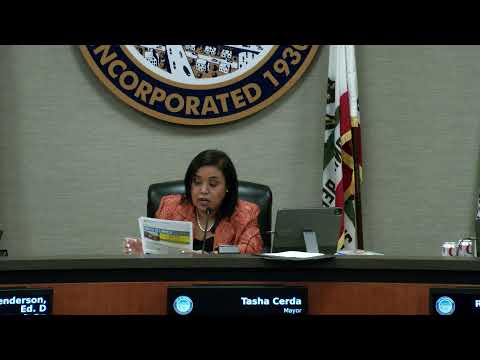
The Gardena City Council voted unanimously Jan. 27 to place a quarter‑cent transactions‑and‑use tax before city voters on the June 2, 2026 ballot and introduced an implementing ordinance.
City staff presented the proposal as a general‑purpose revenue measure intended to help fund public safety, parks and senior and youth services and to retain funding local officials said could otherwise be captured by Los Angeles County. "This is really for us to keep local control here in the city of Gardena," the city manager stated during the presentation.
The council adopted Resolution No. 67‑18 and introduced Ordinance No. 18‑86 on motions made and seconded by Council member Love and Council member Francis, respectively, with the votes recorded as "5 yeas: Serta, Henderson, Tanaka, Francis and Love." Staff estimated the measure would generate about $3,900,000 in annual revenue in a full fiscal year if approved by voters and estimated the administrative cost to place the measure on the June ballot at $38,003.77.
Staff explained the timing was prompted in part by the recent repeal of a county quarter‑cent measure (referred to in staff slides as "Measure H"), which freed a quarter‑cent of taxing capacity that either the county or a city can place on the ballot. City materials listed Measure G (a voter‑approved 0.75% local tax adopted in 2020) as an existing city tax that has already funded large projects including an aquatic and community center. Staff cautioned that legal uncertainty remains about how the California Department of Tax and Fee Administration (CDTFA) would allocate tax capacity if both the county and the city place measures on the same ballot; city attorneys told council the agency has faced similar issues previously and may need to issue a ruling.
Councilmembers discussed that the tax is a general tax and therefore cannot be legally earmarked to a single project. Council member Love confirmed she understood that constraint but asked whether Measure G had already paid for certain projects; staff said Measure G funds are blended with other sources and cannot be strictly earmarked.
If voters approve the proposed quarter‑cent measure, the ordinance would impose the tax but the tax would not be collected unless voters approve it. The council directed staff to return with the ordinance for a second reading in February as part of the normal adoption process.
Provenance: topicintro SEG 975, topfinish SEG 1312