Get AI Briefings, Transcripts & Alerts on Local & National Government Meetings — Forever.
SFPUC adopts two‑year operating budget, two‑year capital budget and 10‑year financial and capital plans
Summary
The San Francisco Public Utilities Commission approved a biannual operating budget, a two‑year capital budget and a 10‑year capital and financial plan after public hearings and staff presentations that flagged major debt‑service-driven capital costs and projected rate increases for water and wastewater customers.
The San Francisco Public Utilities Commission on [date] voted to adopt a biannual operating budget, a two‑year capital budget, a 10‑year capital plan and a 10‑year financial plan after staff described a series of tradeoffs intended to balance infrastructure needs and ratepayer affordability.
Finance staff told commissioners the operating budgets for the next two fiscal years total approximately $2,166,698,799 for the first year and $2,344,066,873 for the second year and that the two‑year capital budget totals about $1,163,787,041 in year one and $1,316,552,550 in year two. Staff said roughly 70% of the 10‑year capital plan will be financed by debt and recommended authorizing the general manager to seek Board of Supervisors approval for debt issuances associated with the capital program; some bond authorization figures in the staff readout were not fully legible in the record and are not specified here.
Erin Corfinova, the commission’s financial planning director, summarized key assumptions behind the 10‑year financial model, including conservative water sales projections, expected increases in debt service and an assumption of 3.5–4% short‑term interest rates with a 6% long‑term bond rate for planning conservatism. Corfinova said staff forecasted near‑term retail water rate increases of about 7% for two years and higher wastewater rate increases (15% and 14.5% in the next two years), driven principally by capital and resulting debt service.
“Capital is the largest driver,” Corfinova said. “Debt service is increasing to around $687 million by the second year of the budget,” and most of the programs in the 10‑year plan address regulatory mandates and the need to renew aging infrastructure.
Commissioners pressed staff on matching bond authorizations to capital program line items and on developer contributions for projects that serve new development, such as Treasure Island and SFO. Corfinova said the capital finance team includes assumptions about developer contributions and offered to provide a crosswalk showing how bond authorizations align with capital expenditures.
Public commenters urged caution on large capital commitments and sought more engagement on specific projects. Several speakers from Millbrae and members of the Bay Area water agencies coalition (BOSCA) urged the commission to delay or separate consideration of a proposed Millbrae operations campus pending additional alternatives and community consultation; SFPUC management clarified that adoption of the capital plan does not itself approve construction of individual projects and that project approvals and CEQA analyses will return to the commission.
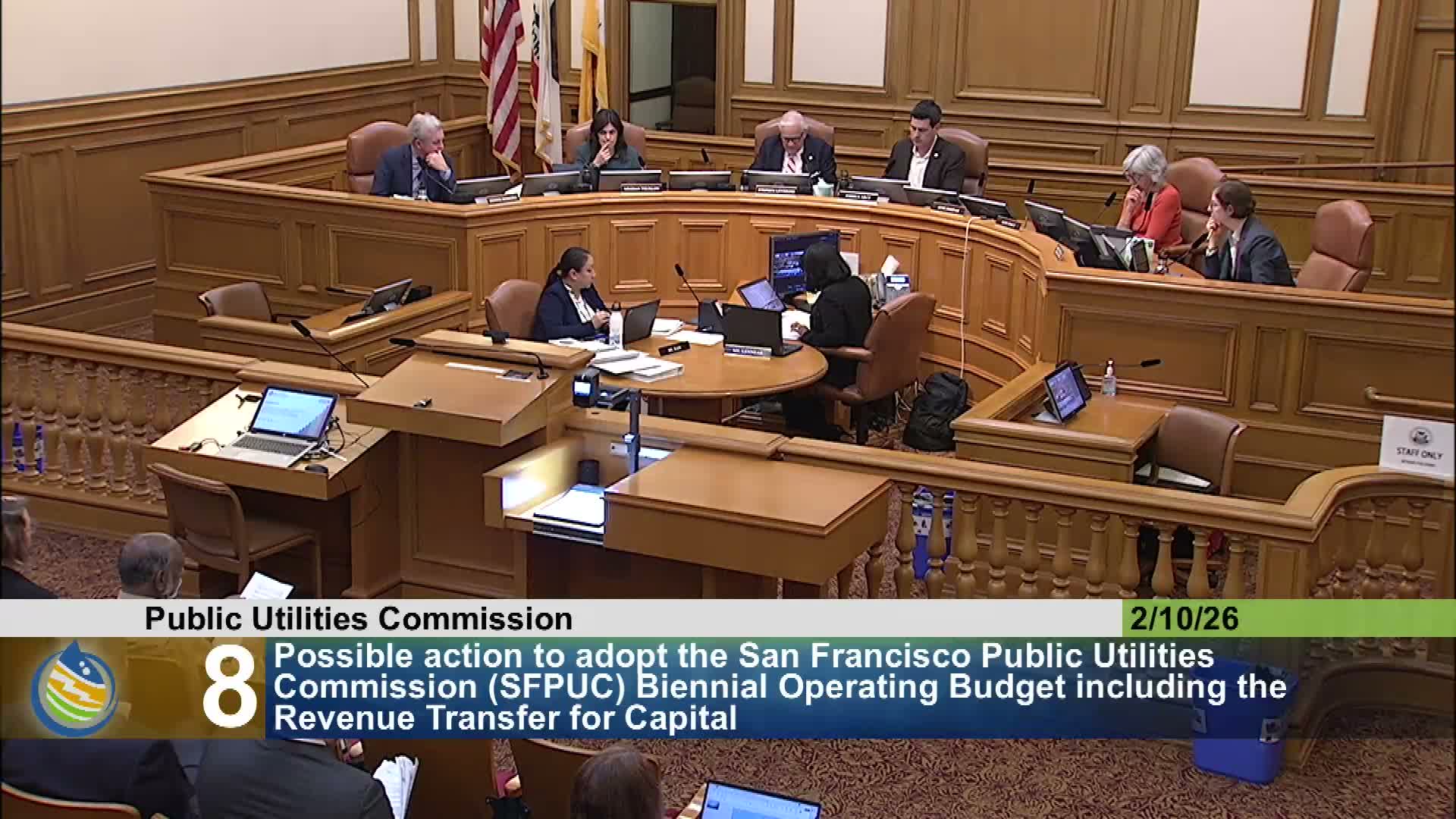
Commissioner Stacy moved to approve each item; motions were seconded and each passed on recorded voice votes with Commissioner Jamdar noted as excused. The items adopted were:
• Item 8 — Adopt the San Francisco Public Utilities Commission biennial operating budget, including the revenue transfer for capital.
• Item 9 — Adopt the two‑year capital budget and authorize the general manager to seek Board of Supervisors approval for debt issuances associated with the capital program (specific bond authorization amounts for some enterprises were not specified in the audible record).
• Item 10 — Adopt the 10‑year capital plan.
• Item 11 — Adopt the 10‑year financial plan (required by the San Francisco charter).
The commission document packet and slide presentation include more detailed tables, and staff said they will provide crosswalks and a 75‑page financial plan report with model assumptions for further review. The commission also emphasized continued efforts to use customer assistance programs (CAP) to keep bills affordable for eligible households; staff said CAP currently reaches about 7,600 households with 25%–40% discounts.
The commission’s action sends the budgets and plans to the next administrative and legislative steps where applicable; project‑level approvals and CEQA actions for specific capital projects will return separately for commissioner consideration.