Get Full Government Meeting Transcripts, Videos, & Alerts Forever!
Get email alerts on the Parks Recreation topic
No spam. Unsubscribe anytime.
Lake Bluff Yacht Club presents smaller boathouse plan; trustees and residents press for safety, aesthetics and resident access
Summary
At a Feb. 9 Committee of the Whole meeting, the Lake Bluff Yacht Club presented a reduced single‑story boathouse and new storage racks intended to expand community access. Trustees and nearby residents praised the smaller scale but raised concerns about fencing, insurance, electricity and a recent bylaw change affecting resident priority.
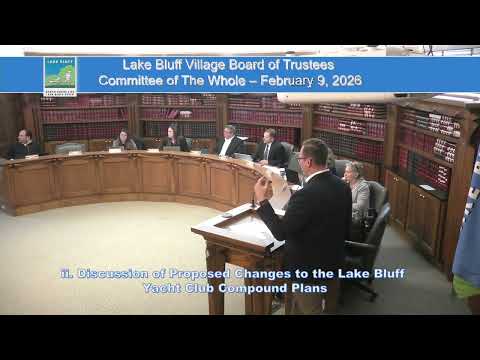
On Feb. 9 the Village of Lake Bluff Committee of the Whole heard a presentation from the Lake Bluff Yacht Club on proposed changes to its lakefront compound, including a condensed single‑story boathouse, new rack storage for club‑owned kayaks and paddle boards, and a decorative fence along the beach.
Taylor Overman, presenting for the yacht club, said the board unanimously scrapped an earlier two‑story design after community feedback and cost reviews and proposed a smaller building intended to “match the aesthetic of this town.” Overman said the club’s goal is to increase public access by offering club‑owned craft for use rather than requiring residents to store and maintain their own equipment.
The proposal calls for what presenters described as a modest boathouse roughly 30 feet wide and 20 feet deep with a peak about 15 feet, 9 inches above grade and a 14‑foot opening large enough to pull rescue boats on trailers, plus a 24‑foot dormer set back four feet to reduce the structure’s visual bulk. Materials under consideration included a galvanized roof and ash or cedar shiplap siding to create a nautical, boathouse look.
Trustees and residents had several consistent concerns. One trustee flagged the club’s insurance limits and urged verification with insurers, noting the potential liability if people climb fences or access the beach after hours. Trustees also pressed the club on fence design: several speakers questioned whether an opaque privacy fence would create wind‑load and maintenance problems on the sandy site, suggested planters or lower, wind‑permeable alternatives, and asked the advisory boards (PCZBA and ABR) to weigh in on aesthetics.
Board members and residents also focused on safety and utilities. A former compound manager and other residents said electricity at the site is important for security lighting and to charge radios and cameras; club representatives said they are pursuing connections with the park district and other local providers but are advancing the zoning application first.
Several trustees and residents raised policy and equity concerns about changes to the yacht club’s bylaws. One trustee said the original 2024 bylaw had given preference to Lake Bluff residents but that a 2025 revision had weakened that preference, calling the change “eviscerated” by legal edits. Club representatives acknowledged an unintended wording change, said they will have counsel review the bylaw language and promised to address the issue so resident priority is preserved where possible. The club also reported a survey of members and current wait‑list applicants that yielded about 80 responses; presenters said the redesigned, more flexible racking should create space to accommodate current Lake Bluff members and those on the wait list.
Public comment included mixed responses: some residents recommended tying the new building’s roof and materials to nearby structures for visual cohesion, while others emphasized that a functional, safe compound that expands access for youth and families is the primary goal. Multiple speakers urged the club and village to consider planter boxes or other low‑maintenance landscaping to screen storage without creating excessive wind loads.
Staff summarized next steps: the Rio plan amendment and related zoning items will go to the PCZBA and ABR for advisory review, with village staff and the club working together to address safety, insurance, fencing and bylaw wording before returning to the village board for final action. The Committee approved minutes from a prior meeting by voice vote earlier in the session and adjourned after the LBYC discussion.
The village’s advisory review process and any insurer reviews were the most recent procedural steps noted; the project will return to the village board after PCZBA and ABR consideration.