Get Full Government Meeting Transcripts, Videos, & Alerts Forever!
Get email alerts on the Governance topic
No spam. Unsubscribe anytime.
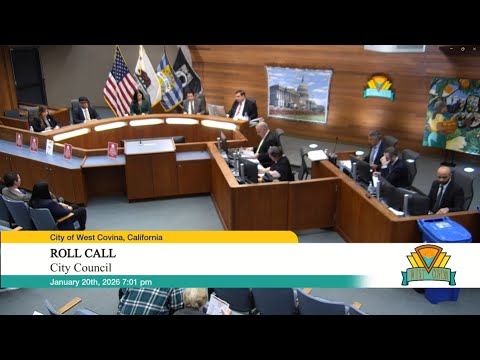
West Covina council adopts code of conduct ordinance after lengthy debate over acknowledgment clause
Summary
After extensive public comment and council discussion, West Covina—039s City Council approved a code of conduct ordinance (first reading adopted) and a companion resolution clarifying intent; council agreed to minor edits to the notice-and-acknowledgement language and asked staff to consider applying the rules to other elected officials.
The West Covina City Council on Jan. 20 advanced a citywide code of conduct and adopted a legislative-intent resolution after a long debate over scope, safeguards and whether a notice-and-acknowledgement should be a condition of taking office.
Tom O—039Connell, outside counsel retained to draft the ordinance, told the council the measure is divided into four parts: general provisions, standards of conduct (including abuse of power, harassment and misuse of city resources), reporting and review procedures, and governance-based measures the city could impose in response to findings. "This lays out the cornerstone of the city's code of conduct," O'Connell said during the meeting.
Council discussion focused on procedural safeguards and the language of a notice-and-acknowledgement. Councilmember Gutierrez repeatedly asked whether the acknowledgment could be used to restrict an elected official—039s participation in meetings or otherwise create a legal prerequisite beyond the constitutional oath. O'Connell replied that the acknowledgment is intended as a notice that a member received training and that, as drafted, it would not create a new legal prerequisite to serve. He also proposed non-substantive edits — removing or reordering clauses that could be read to make the acknowledgment a precondition for taking office — which Gutierrez said would address his concern.
After amendments and public comment (some speakers urged broader application and greater transparency), Councilmember Tony Wu moved to approve the ordinance (with Agreed clarifying edits) and Councilwoman Rosario Diaz seconded the motion. The council voted unanimously on the motion for the first reading of the ordinance and adopted Resolution No. 2026-10 clarifying legislative intent.
Mayor Lopez Villarro framed the measure as an effort to update longstanding rules of decorum and create a transparent, structured process for addressing alleged misconduct by council members. "We want to make this public, we want to be transparent," she said. Supporters emphasized that the ordinance creates formal protections and procedures to address harassment, retaliation and other misconduct and that it includes safeguards against misuse of the process.
The council directed staff to return with associated administrative policies and implementation details (for example, badge and access rules, meeting decorum procedures and any separate policies for commissions) and agreed that members should be able to provide feedback before the second reading and final adoption.
Next steps: the ordinance returned from first reading with non-substantive edits as discussed; the council adopted the resolution of intent and scheduled follow-up policy work to implement procedural details.