Get Full Government Meeting Transcripts, Videos, & Alerts Forever!
Get email alerts on the Waste Management topic
No spam. Unsubscribe anytime.
Athens Services outlines SB 1383 rollout for West Covina; residents to get three carts, collection starts mid-February
Summary
Athens Services told the West Covina City Council that state SB 1383 requires major changes to residential and commercial waste collection, and said commercial deliveries start immediately, residential barrel delivery begins Feb. 2 and collection will start the week of Feb. 16; the company described contamination monitoring and an education plan.
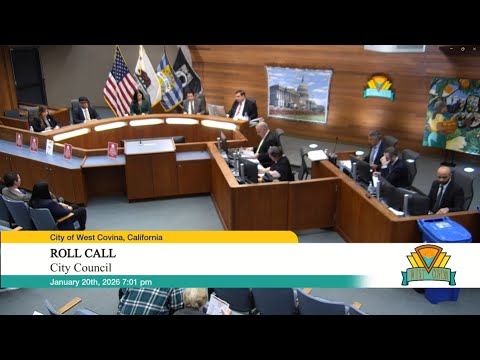
Athens Services gave West Covina officials a detailed plan on Jan. 20 for implementing California—039s SB 1383 organic-waste rules, telling the City Council the law requires municipalities and haulers to recover a large share of organic material from landfill-bound trash.
"SB 1383—039 requires many elements including the most visible to all of us, compliant containers for both residential and commercial customers," Jonathan Hughes, vice president of government affairs for Athens Services, told the council during a presentation and Q&A. He said residential customers will receive three carts — trash (black), organics (green) and recycling (blue) — in matched sizes (32-, 64- or 96-gallon) and that commercial and multifamily customers would get a mix of bins and barrels sized to their needs.
The company laid out a phased schedule: commercial and multifamily equipment deliveries could begin "as soon as next week," residential barrel deliveries are planned to start Feb. 2 and continue for about two weeks, and collection using the three-stream service is set to begin the week of Feb. 16. Athens said all carts will feature SB 1383-compliant labeling, including hot-stamped lids and stickers with QR codes linking to educational materials.
Athens described seven elements of the statewide program: collection, container color and labeling standards, contamination monitoring, route-based waste assessments, outreach and education, procurement to build recycled-product markets, data reporting to CalRecycle and food-recovery support for large food generators. "Contamination monitoring mandates the ongoing monitoring of barrels and bins to ensure proper sorting," Hughes said, noting route auditors conduct periodic "lid flips" and that fees can be assessed for repeated contamination.
Council members and residents pressed Athens on fees and enforcement. Councilman Gutierrez asked whether penalty or stabilization charges could be deemed unlawful under precedent he cited (the transcript references a case by name); city attorneys declined to discuss potential liability during the vendor presentation and invited written questions. Athens said contamination fees would typically be considered only after repeated violations and that assessed penalty revenue would be returned to the city to administer SB 1383 enforcement and education activities.
On outreach, Athens said its team will visit commercial and multifamily customers annually, provide on-site training (including examples for restaurants), and supply a reporting dashboard to the city to support CalRecycle compliance reporting. The company also offered residents practical guidance at the meeting: food waste goes in the green organics cart (it can be placed loose or in a clear or paper bag), palm fronds and some bulky yard materials may still be trash because they do not decompose quickly, and bulky-item pickup remains available with a 24-hour scheduling window.
Acting City Manager Mylan and councilmembers asked Athens to provide more detailed visuals and cheat sheets for residents; Athens said educational materials and staff will be available in the community room after the meeting and at outreach events.
Next steps: Athens will continue community outreach, begin the staged equipment deliveries, and work with city staff on enforcement timing and public education. The council and staff agreed to accept written legal and contract questions for follow-up rather than addressing liability during the presentation.