Get Full Government Meeting Transcripts, Videos, & Alerts Forever!
Get email alerts on the Capital Outlay topic
No spam. Unsubscribe anytime.
Senate committee advances House Bill 2 with new guardrails for capital outlay; requires ICIP for projects over $100,000
Summary
A Senate committee adopted an amendment requested by the Board of Finance to add administrative guardrails and reporting for stalled capital outlay projects and voted 90–0 to give House Bill 2 a due pass as amended. The measure requires projects of $100,000 or more to appear on an ICIP and sets encumbrance and reauthorization limits.
The Senate committee advanced House Bill 2 on a unanimous voice and roll-call showing, approving an amendment that adds administrative requirements for stalled capital outlay projects and sending the bill to the floor with a recommendation for passage.
The committee adopted an amendment requested by the State Board of Finance that requires additional documentation and due diligence around projects funded with severance tax bonds and creates an administrative framework to identify inactive projects and why funds were not spent. "This is being proposed by Board of Finance to just protect against, tax liability," Ashley H, director of the State Board of Finance, told the committee.
The amendment and the bill as amended would also limit reauthorizations of capital outlay appropriations to no more than once in two years, allow only technical reauthorizations that do not change the original purpose, and require that at least 10% of an initial appropriation be encumbered by Jan. 1 of the year the authorization would otherwise revert. The bill text further specifies that the 10% may not be used for administrative fees.
A major policy change in the measure requires projects, and equipment requests, of $100,000 or more to appear on an Infrastructure Capital Improvement Plan (ICIP) to be eligible for capital appropriations. Committee members and staff said the Department of Finance and Administration's infrastructure division will provide training and assistance so small local entities can prepare ICIPs. "The intent is not to be punitive, but to be able to be all encompassing and provide that support that the state needs," a committee presenter said.
Several senators pressed for clarity on how small, volunteer-run entities would comply. Senator Padilla asked how the smallest communities would obtain an ICIP designation; presenters said DFA set up staff and training to help smaller communities prepare the planning documents so they can remain eligible.
The committee also debated narrower policy language. Senator Steinborn raised concerns that line 18 could allow money to flow to private geothermal projects and suggested limiting geothermal and microgrid appropriations to publicly owned projects; that motion failed for lack of a second. Senator Steinborn said privately funded geothermal developers with large capital resources "do not need our $10,000,000." The chair and staff responded that geothermal awards would go through an application and grant process.
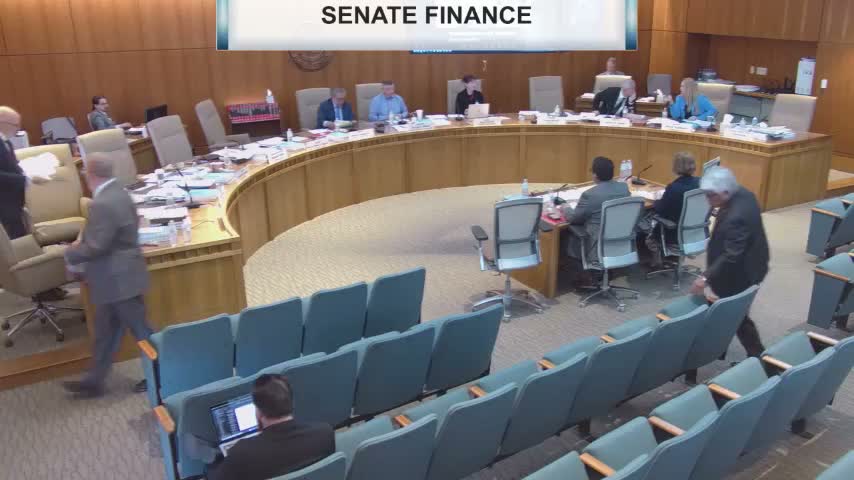
Procedurally, the committee first moved the amendment for discussion (motion by Senator Trujillo; second by Senator Lanier) and later adopted the amendment (mover: Senator Gendo; seconder: Senator Trujillo). Senator Shindo then moved, and Senator Trujillo seconded, that the committee give House Bill 2 a "due pass as amended." The clerk recorded a roll-call and announced, "due pass as amended, 90 in the affirmative, 0 in the negative." The committee chair said members would return after floor action to finalize language.
The amendment was described by sponsors and DFA/Board of Finance staff as a measure to protect the state from IRS scrutiny in the municipal-bond market by creating a permanent record and additional due diligence for reauthorizations and for funds that show no spending activity.
Next steps: the committee sent House Bill 2 to the floor with a due-pass recommendation and will reconvene after caucus/floor action to clean up final language.