Senate committee backs $1.1M for Mora water system planning and treatment upgrades
Loading...
Summary
Senate Bill 310, which would appropriate $1.1 million from the general fund to the Environment Department for planning, design and construction improvements to the Mora Mutual Domestic Water system, received a do‑pass recommendation from the Senate Conservation Committee, 5–3. Testimony stressed wildfire and post‑fire flooding impacts, heavy‑metal contamination in private wells, and the need to reduce infiltration/inflow and upgrade treatment.
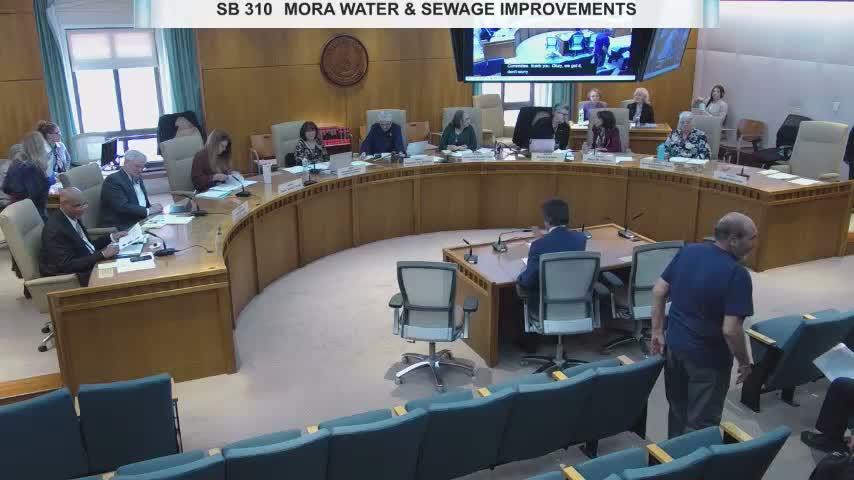
The Senate Conservation Committee recommended passage of Senate Bill 310, a $1.1 million general‑fund appropriation to the New Mexico Environment Department for planning, design and construction improvements to the Mora Mutual Domestic Water system. The committee voted to give the bill a do‑pass recommendation by 5 votes to 3.
Sponsor Senator Campos described SB310 as an appropriation to support planning, design and construction for water and wastewater improvements for the Mora mutual system. Local board member Andrew Sanchez told the committee the system is aging — "30 years, 40 years" in places — and faces an administrative order from the Environment Department related to discharge into the Mora River. "We would like to find another alternative," Sanchez said, adding the community needs investment to provide safe drinking water.
Technical witnesses described watershed and treatment challenges. Ramon Lucero, regional manager with the Rural Community Assistance Corporation, said the mutual system serves about 375 water connections and roughly 142 sewer connections, and that inflow and infiltration (I&I) has inflated treatment volumes from an expected 50,000 gallons per day to about 150,000 gallons per day. He said those conditions make treatment costlier and cited existing Clean Water State Revolving Fund design funding of roughly $540,000 and a pending Water Trust Board request of about $1.8 million for other phases of the project.
Education and public‑health witnesses linked infrastructure needs to community impacts. Dr. Fidel Trujillo, interim superintendent for Mora Independent School District, cited the Hermits Peak‑Calf Canyon fires and post‑fire flooding as factors leading to downstream well contamination, saying "lab confirmed heavy metal contamination in private wells across Mora County" and that protecting regulated community water systems remains urgent.
Committee members asked about total project cost and funding strategy; experts said a preliminary engineering report (2020) estimated total project costs at "a little bit over $5,000,000," and that a mix of Clean Water SRF, Water Trust Board requests and the requested $1.1 million appropriation would be used because of program match and award limits. Senators expressed support for developing workforce training and local hiring commitments in any future implementation.
After questions, the committee adopted a do‑pass motion and advanced SB310 with a 5–3 vote. The bill will move forward through the legislative process for further consideration.