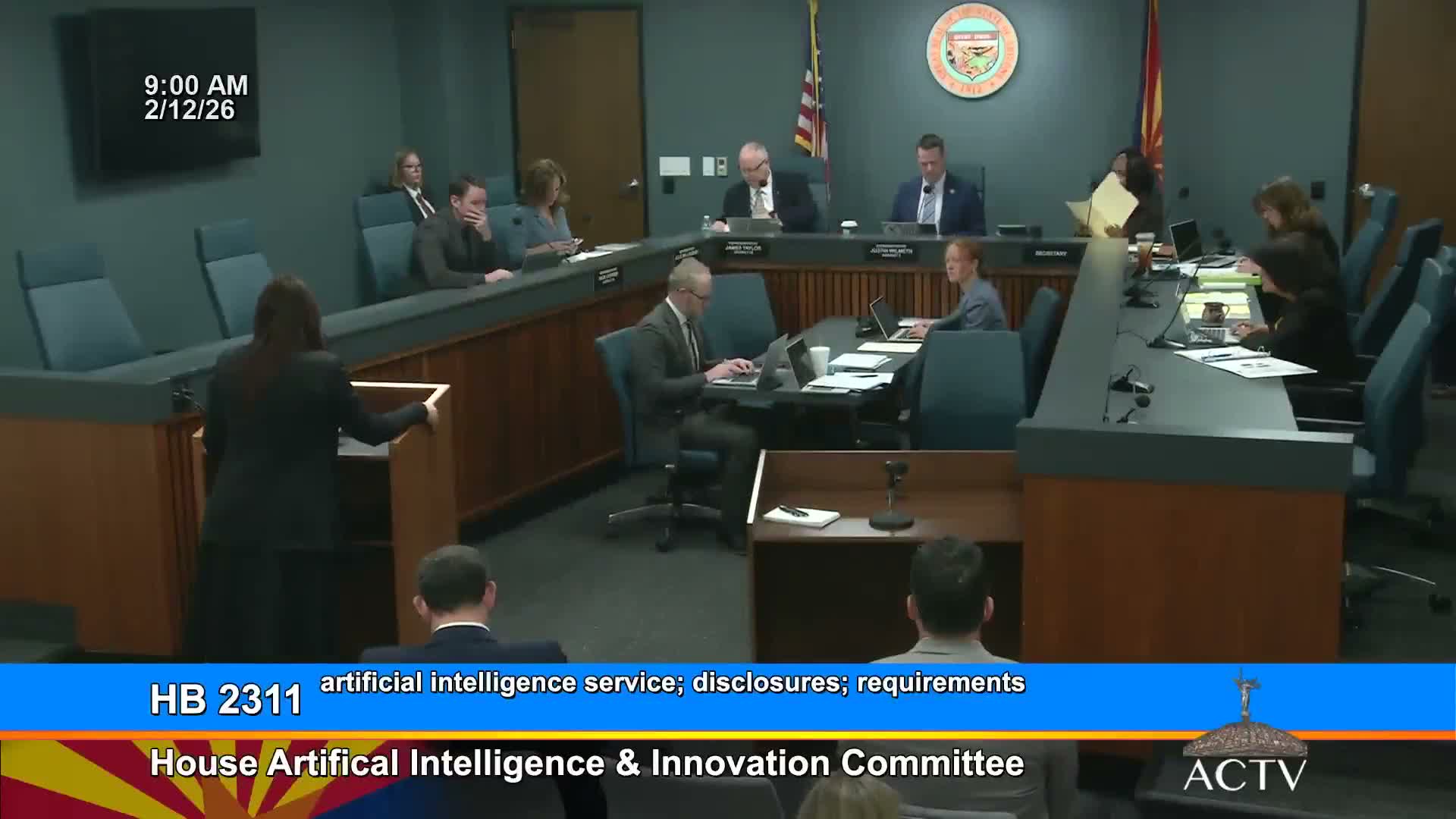
Committee adopts amendment and advances bill requiring disclosures and safeguards for minors using conversational AI
Loading...
Summary
House Bill 23‑11, as amended, would require conversational AI systems to disclose to minor users that they are interacting with AI, maintain periodic disclosure banners, restrict exposure to sexual material and include suicide/self‑harm response protocols; the committee adopted a four‑page amendment and returned the bill with a due‑pass recommendation.
Staff summarized House Bill 23‑11 and an accompanying four‑page Wilmoth amendment dated 02/11/2026 that expands the definition of conversational AI and clarifies liability for third‑party operators. The bill would require operators to notify minor users at the start of each session and at least once every three hours, display a persistent banner for minors, prevent AI from impersonating humans in ways that would mislead minors, limit exposure to sexual material and adopt protocols to respond to expressions of suicidal ideation, including reasonable efforts to refer the user to crisis services.
Sponsor Representative Rivera said the bill takes a risk‑based approach to treat children and teens differently than adults and stressed parental controls, disclosure requirements and suicide‑response protocols. "Gen AI can help younger people ... but we must provide protections," Rivera said.
Colin Larson, representing Google, testified in support and said Google’s product design already contains many of the guardrails in the bill, including persona safeguards and crisis referrals. Larson said the bill would help codify an industry‑wide floor for safety features and noted that similar language has appeared in California and Utah legislation and is being considered in other states.
Committee members asked about the civil penalties in the draft (questions were raised about a $1,000 per‑violation amount and a $500,000 cap) and about liability for developers versus operators. Staff and witnesses said the amendment attempts to clarify liability but could not provide a policy history for the exact penalty figures during the hearing.
A public witness (Jeanne McDoua, written testimony entered) objected to the bill as government overreach; staff noted the testimony was entered into the record. After debate, the committee adopted the Wilmoth amendment and returned HB 23‑11 as amended with a due‑pass recommendation.
What happens next: Sponsors signaled willingness to refine liability, penalty and privacy language with stakeholders and noted other states are considering related frameworks.