
Arizona committee backs pilot program to let consenting couples use AI in simple divorces
Get AI-powered insights, summaries, and transcripts
Subscribe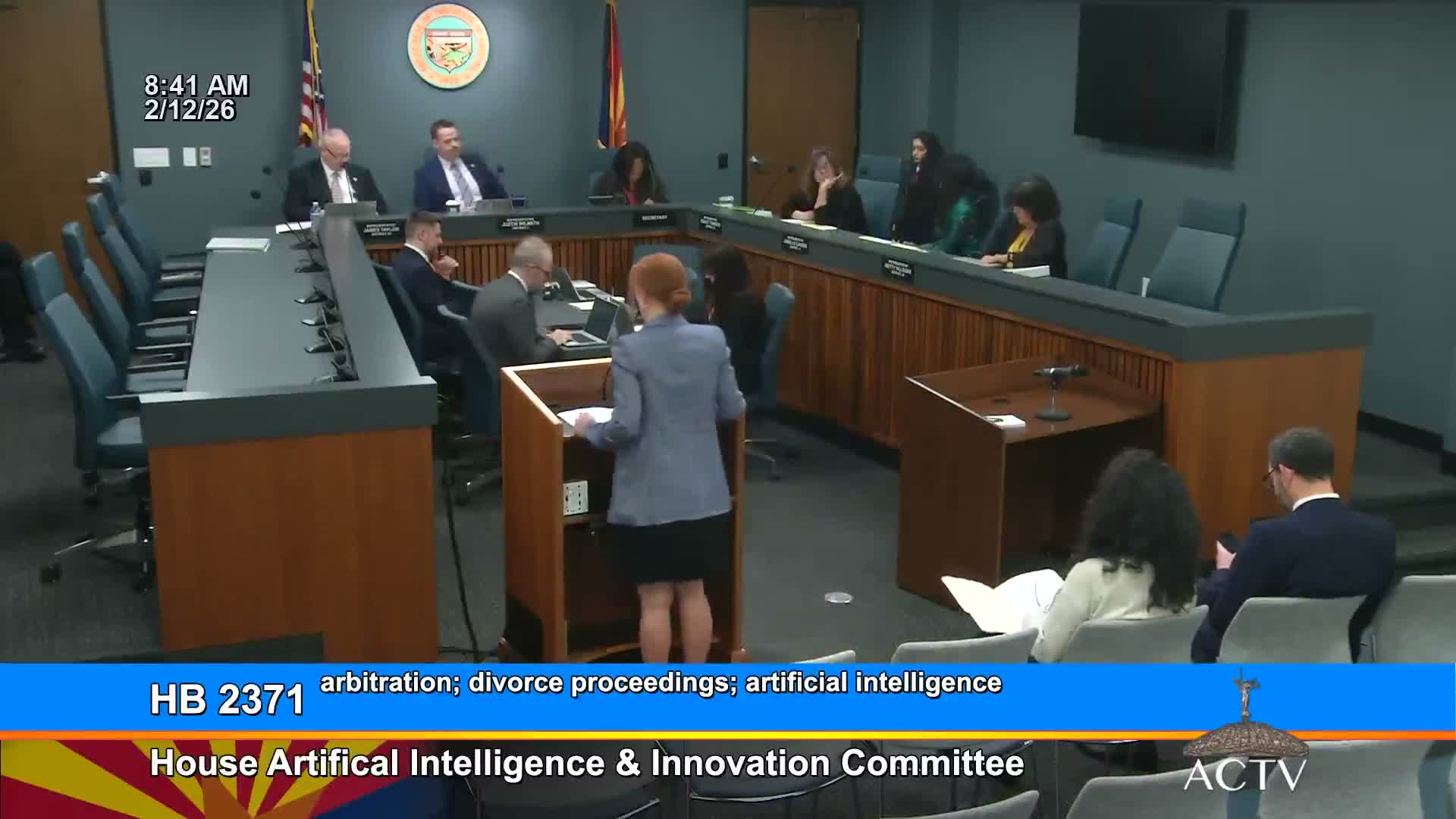
Summary
The Committee on Advanced in Artificial Intelligence and Innovation returned House Bill 23‑71 with a due‑pass recommendation to allow AI‑assisted arbitration in simple divorces without minor children, with judges retaining final authority and the bill limited to a pilot for straightforward asset divisions.
Representative Theresa Martinez introduced House Bill 23‑71 as a pilot that would permit couples who both consent and who do not have minor children to use AI‑assisted arbitration in simple divorce cases.
"This is about fairness. It's about justice," Martinez said, describing a constituent who lost most marital assets after a mediation and saying a divorce calculator could have produced a fairer starting point. Martinez emphasized the proposal is voluntary and that "the judge will have the final say," adding she is open to amendments to tighten the language and include asset‑division and privacy guardrails.
Staff told the committee the measure applies only when both parties consent, excludes cases with minor children and is intended for straightforward situations such as one house, one or two vehicles and limited retirement or Social Security issues. Martinez said the pilot will exclude complex estates, business interests or offshore assets.
Members asked whether an AI determination could be binding. Representative Taylor and others sought clearer statutory language to ensure the judge retains ultimate authority; Martinez said any ambiguities can be fixed by a floor amendment and reiterated her intent that AI recommendations remain an "offer" for judges and parties to consider.
Committee members also pressed Martinez to make explicit how assets and spousal support are handled in the pilot. Martinez responded the bill will include a focused asset‑division model for basic cases and that spousal support would be optional within the pilot.
After brief remarks of support and a pledge to work on amendments, the committee moved and voted to return HB 23‑71 with a due‑pass recommendation. The chair announced the measure passed the committee vote with seven ayes and no nays.
What happens next: The bill is scheduled for further work on the floor, where sponsors and members indicated they expect to file amendments to clarify binding authority, asset definitions and privacy protections before a final vote.