
Corvallis schools outline new 7–8 math pathways aimed at universal Algebra‑1 readiness
Get AI-powered insights, summaries, and transcripts
Subscribe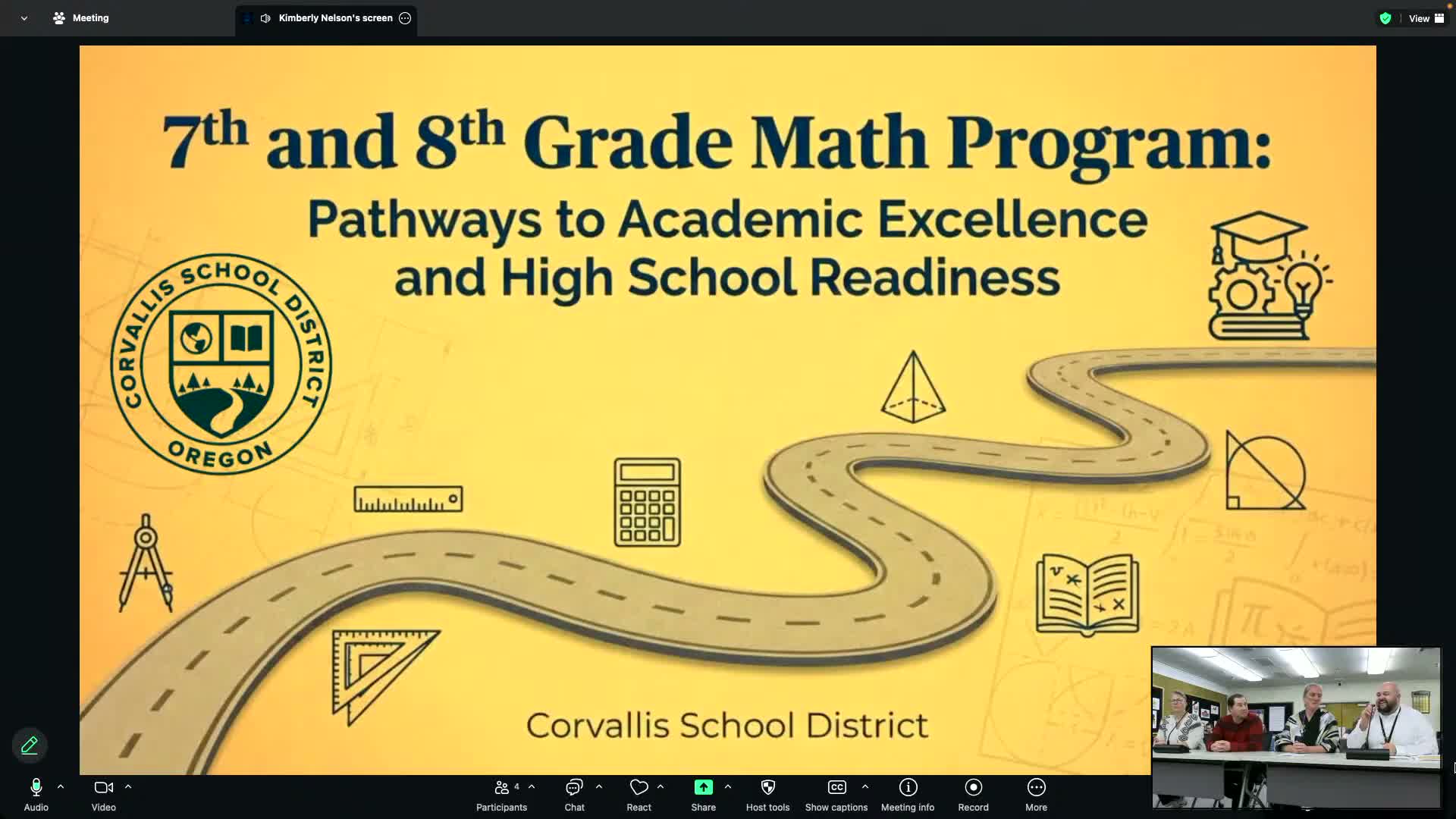
Summary
District staff presented OSAS recovery data and proposed a three‑pathway 7–8 model (standard, enhanced, accelerated) plus intervention classes and asynchronous options to increase access to Algebra 1 and later advanced coursework; high‑school planning will begin in March.
District staff presented a comprehensive update on middle‑school mathematics at the Corvallis School District 509J board meeting Feb. 5, outlining a multi‑track plan intended to ensure Algebra‑1 readiness for all students by the end of eighth grade.
Byron Bethords, the district’s director of student growth and experience, opened the presentation with statewide assessment trends and local OSAS data showing recovery since COVID and gains in seventh‑ and eighth‑grade performance. “Our goal is remaining the same, Algebra 1 readiness for all students,” Bethords said, placing recent test improvements in the context of targeted interventions and curriculum alignment.
The district proposed three pathways for grades 7–8: a standard track (pre‑algebra in 7th, Math 8/foundations in 8th), an enhanced track with multiple entry points allowing students to take Algebra in eighth grade, and an accelerated track that requires a proficiency assessment at the end of sixth grade. Jared Kalis, a seventh‑/eighth‑grade teacher, summarized the intent: students should “either [have] passed Algebra 1 already or [be] ready to take algebra as ninth graders.” Staff also described asynchronous course modules and sustained intervention classes designed to reduce the number of students scoring at the lowest achievement level.
Presenters highlighted early wins: Corvallis has regained ground on state assessments with some subgroups showing significant gains, and increased participation and higher scores in dual‑credit and AP math exams. The panel said intervention classes piloted at the middle school level this year will remain part of next year’s model and be scheduled to target specific domains (for example, fractions or algebraic operations) on a trimester basis.
Board members pressed staff on access to the most advanced courses. “If enough students are able to forecast for it, could [Calc BC] come back into the high school instead of going out to LBCC?” asked board member Judah, referring to Advanced Placement/college‑level pathways. Staff replied that a path to Calc BC is possible but depends on forecasting, staffing and high‑school planning that begins in March; the district intends to explore in‑house options and continued external partnerships with LBCC and OSU to maximize access.
On equity, staff noted Corvallis performs at high levels despite serving higher percentages of students who are English learners, experiencing poverty, or mobility, and said the pathway design aims to preserve multiple entry points so students can move between tracks as they demonstrate readiness.
The presentation closed with an invitation to a community math night: a high‑school and college readiness panel at Crescent Valley High School Auditorium 5–6 p.m. on the coming Monday, where university and college panelists will answer family questions about readiness and postsecondary options.
Next steps: staff will continue refining the 7–8 model and begin focused high‑school programming work in March; the board and public will receive further updates as planning produces concrete implementation timelines.