Get Full Government Meeting Transcripts, Videos, & Alerts Forever!
Get email alerts on the Land Use Dispute topic
No spam. Unsubscribe anytime.
Council rejects mediated settlement in high‑stakes Vestera PUD dispute after hours of testimony
Summary
A proposed mediated settlement to allow an increased density in the Vestera (GCCF/Neil) PUD and related height exceptions failed 3–4 after extended staff presentations, developer arguments, testimony from the FLUDRA magistrate and public comment raising density and height concerns.
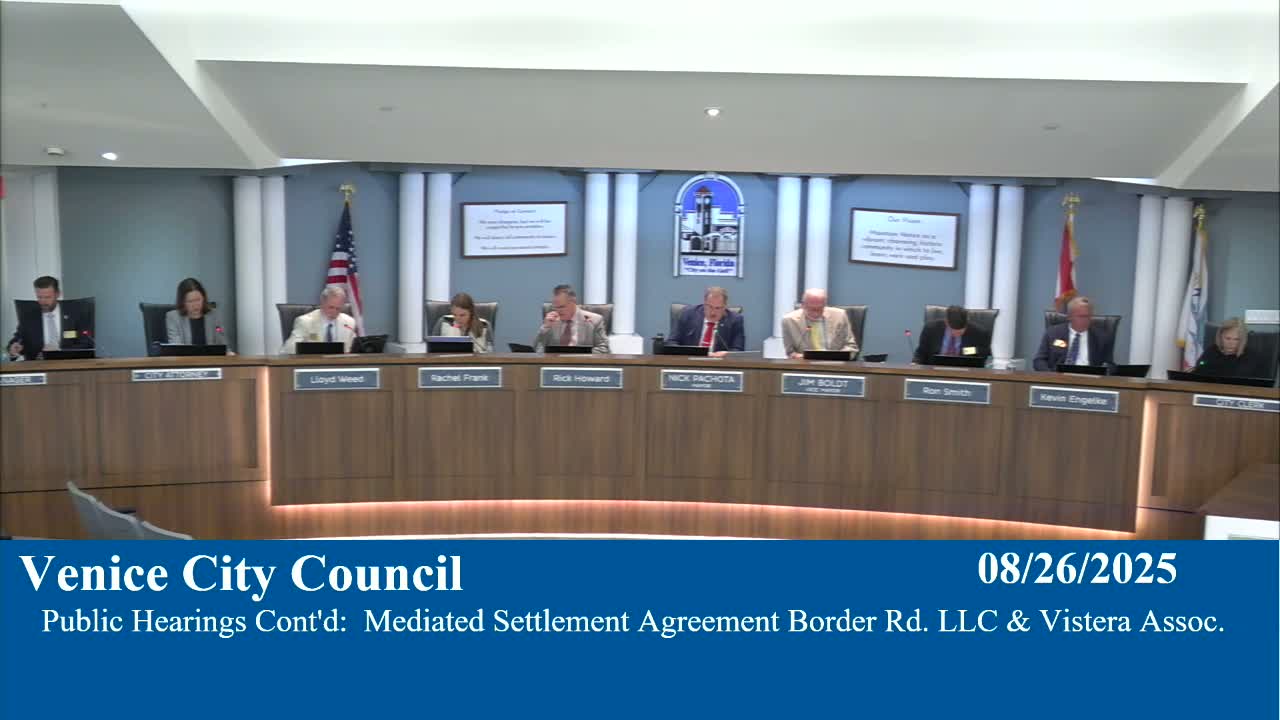
After more than three hours of presentations, public comment and back-and-forth between counsel, the Venice City Council declined to approve a mediated settlement in a long-running land-use dispute over the Vestera (GCCF / Neil Communities) Planned Unit Development.
Background and settlement terms: The original application sought to raise permitted density from 1,300 to 1,617 dwelling units across the PUD (5 du/acre). Under the mediated settlement presented under the Florida Land Use and Environmental Dispute Resolution Act (FLUDRA), the applicant would be allowed the 5 du/acre density but would be restricted to place up to 370 of those additional units on a 17.46-acre parcel near Laurel Road. The draft settlement also would add assisted-living, independent living and memory-care uses as permitted principal uses on that parcel, update lot and signage standards, and allow height exceptions (multifamily up to 55 feet; ALF/independent/memory care up to 65 feet) —subject to separate review and approval.
Process and legal context: City Attorney and staff reviewed the FLUDRA history: the original application was denied 4–3, the applicant invoked FLUDRA and the parties mediated with Mark Bentley serving as mediator/special magistrate. Staff and outside counsel told council the settlement was the best feasible compromise to avoid costly litigation and to preserve single-family areas to the south and east of the PUD by confining higher intensity to the northern parcel.
Arguments and concerns: Proponents (developer Pat Neal and counsel Jeff Boone) argued the settlement protects single-family areas by clustering higher intensity near already denser development and the hospital campus, and that the FLUDRA process enables practical compromises. Opponents (residents and several council members) said the deal grants the applicant essentially the full density it sought plus additional concessions (height and uses) that were not before the council at the original hearing, and they raised worries about traffic, massing, and the absence of enforceable affordable‑housing commitments. Several residents testified against the settlement during audience participation, noting the scale and height (21 units/acre concentrated on 17 acres would be much denser in practice) and urging the council to decline the agreement and proceed to step 2 of the FLUDRA process or litigation.
Outcome: After extensive exchange and multiple attempts to frame alternative compromises, the council voted 3–4 to reject the mediated settlement, with the motion failing. The city will next consider FLUDRA step 2 options or litigation if the applicant pursues them; staff said the applicant already filed a height-exception application that will move separately through the normal planning commission and council hearings.