
Judge Boyd grants deferred adjudication for Clinton Dixon; Romano and Garcia receive supervision agreements
Get AI-powered insights, summaries, and transcripts
Subscribe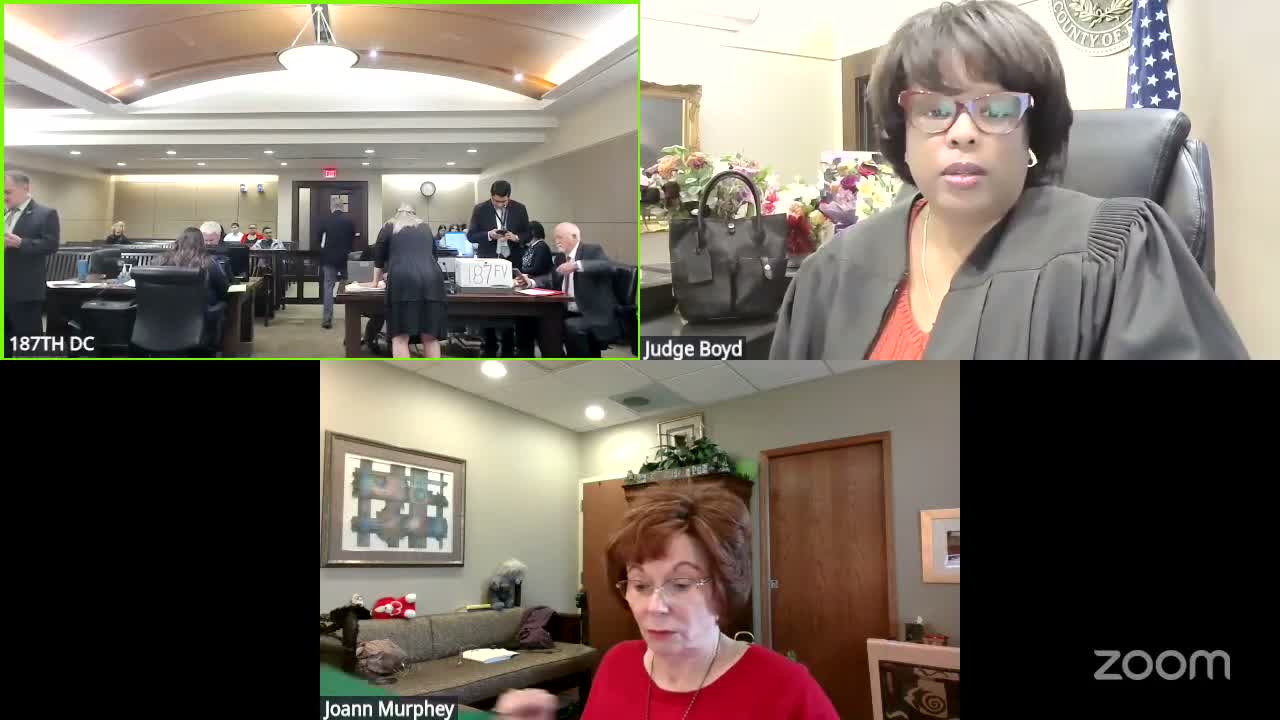
Summary
At a crowded docket in the 187th District Court, Judge Stephanie Boyd granted deferred adjudication with extensive conditions for Clinton Dixon, converted Gina Romanoto a guilty finding with five yearsprobated supervision, and accepted a deferred-adjudication plea for Antonio Garcia with treatment conditions and a TAP evaluation.
Judge Stephanie Boyd presided over a busy docket in the 187th District Court that included pleas, violations and probation-related hearings. After hearing testimony and expert evaluation, the court offered Clinton Dixon a choice between imprisonment and a structured deferred-adjudication program and granted deferred adjudication with conditions.
The judge said she would "grant your application for deferred adjudication," following testimony from defense psychologist Dr. Joanne Murphy and a state witness who described injuries sustained during an alleged robbery. Dr. Murphy told the court she believed Dixon needed mental-health and substance-abuse treatment and described a history of childhood trauma, extended incarceration and prison victimization.
Under the court's order for Dixon, he will remain in custody until transferred to a designated safety facility, be considered for referral to felony drug court while in custody and follow TAP and mental-health recommendations. The court ordered full GPS monitoring upon release unless employment status warranted modification, required proof of employment within 60 days of release, imposed a $2,000 fine to be probated, and set a restitution hearing for March 16. The judge also ordered 300 hours of community-service restitution with reductions for verified sober-support meetings.
In a separate matter, Gina Romano admitted a violation of her deferred-adjudication conditions. The court found the violation true, entered a finding of guilt and placed Romano on five years of community supervision with conditions including weekly reporting for 60 days, random urine analyses, 200 hours of community service (100 hours credited after completion of court-ordered parenting classes), and a $1,000 probated fine.
Antonio Garcia entered a no-contest plea and the court accepted a deferred-adjudication agreement for a 10-year term. The court ordered a TAP evaluation, referral to felony drug court, anger-management and MRT classes as recommended, random UAs, proof of employment within 30 days, and a $1,000 probated fine with restitution payable to the complainant.
The court also handled a range of administrative and procedural matters: the judge scheduled competency re-evaluations and mental-health referrals in several files, arranged a veterans treatment court introduction for at least one defendant, and continued or reset multiple plea deadlines and contest hearings. In one case (Christopher Saldanha, aka Christopher Cruz) the court found a violation and recalled the matter for a decision on plea and set a February 19 follow-up.
The court's orders emphasized treatment and supervision alternatives to incarceration where the court found mental-health or substance-abuse needs, while reserving incarceration where the defendant or the record indicated higher risk or repeated noncompliance. The court set multiple follow-up and status dates across dockets, including a March 16 restitution hearing and other appearances in mid-to-late February.