Get Full Government Meeting Transcripts, Videos, & Alerts Forever!
Get email alerts on the Tax Increment Reinvestment Zone topic
No spam. Unsubscribe anytime.
Navasota council reviews TIRZ basics and first development agreement tied to Ultimera project
Summary
At a Feb. 9 special meeting, council members heard a detailed presentation on the city's Tax Increment Reinvestment Zone (TIRZ) program, the financing mechanics behind a 50% city participation rate, and the first executed development agreement for the Ultimera subdivision; council discussed county participation, PID interactions and transparency resources.
Unidentified Presenter gave a PowerPoint overview of the city's Tax Increment Reinvestment Zone (TIRZ) framework at a Feb. 9 special meeting of the Navasota City Council, and noted the council would later consider a development agreement executed by the developer for the Ultimera subdivision.
The presenter said a TIRZ is "basically a geographic area in which an elected body, the city council in this case, wants to encourage development and growth," and explained the mechanism: the city established a base valuation and agreed to direct 50% of the city's tax growth on that base into a dedicated tax-increment fund to reimburse eligible public infrastructure projects.
Why this matters: The TIRZ channels future local tax growth into capital projects that serve new development (streets, water and sewer lines, sidewalks, stormwater, parks and other public facilities). By allowing developers to front those costs and recover them from future incremental tax receipts, the city aims to spur annexation and residential subdivision in its ETJ while limiting immediate general-fund spending.
Key details presented: the council created the Navasota TIRZ in September 2023; the project plan and financing plan were prepared in January (document dates on file); total approved project cost categories are roughly $22,500,000; the TIRZ boundary covers nearly 3,000 acres in the city limits and extraterritorial jurisdiction; and the TIRZ financing horizon runs through tax year 2052 (the speaker said the final tax year would be 2053 as part of the 30-year plan). The presenter also said the first development agreement tied to the TIRZ has been approved by the TIRZ board and executed by the developer and is on the council's agenda for consideration.
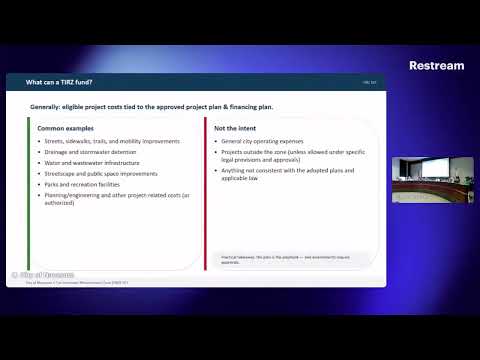
Public Infrastructure Districts and reimbursements: The presenter explained the proposed development uses both a TIRZ and a Public Improvement District (PID). He said costs will be separated so that each reimbursable expense is claimed only once and that some off-site improvements (including an additional water plant and extended service lines) increase development costs; eligible projects listed included streets, sidewalks, drainage, water and wastewater infrastructure, parks and public facilities. The presenter repeated that reimbursement is "pay-as-you-go": "until the money is there, we are not obligated to put any city dollars out except for what is put into the TIF by the incremental increased value."
County and other taxing-unit participation: Council members asked whether the county or school district had been asked to participate. A Hawesville representative (the TIRZ administrator present) said the county was approached and declined at the time; the representative added other units can join later under statutory rules in some cases. The presenter and the administrator noted that school districts in Texas rarely participate now because the state's rules typically make participation disadvantageous for them.
Transparency and governance: The presenter described governance steps the council had taken (an ordinance creating the zone, an appointed seven-seat board with two seats reserved for potential participant taxing units, and a requirement for annual reports). He directed the council and public to the city website's TIRZ board landing page, where the project plan, financing plan, boundary map and meeting packets are posted for public review.
Council follow-up items: Council members asked whether past city-funded infrastructure (for example a water well) could be submitted for reimbursement; the presenter confirmed the city could submit those project costs for reimbursement if they are eligible and if funding remains after developer reimbursements. One council member suggested reapproaching the county at a later date.
Next steps and status: The presenter said the development agreement before council is fully executed by the developer and will become finalized when the council approves it. No formal vote or outcome on the development agreement is recorded in the provided transcript segment.
Sources and attribution: Direct quotes and technical descriptions are taken from the meeting presentation delivered by an unidentified presenter (first speaker at SEG 017), a Hawesville representative (SEG 526), and follow-up council exchanges captured throughout the presentation (SEG 212'SEG 493). The meeting materials referenced by the presenter are posted on the city's TIRZ board web page per the presenter's instructions.