
Virginia Beach board considers tighter rules for student-led demonstrations
Get AI-powered insights, summaries, and transcripts
Subscribe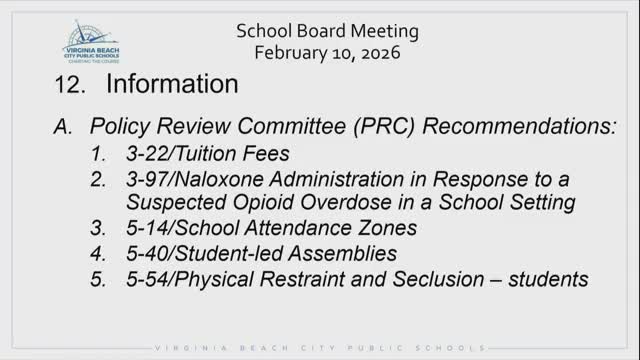
Summary
The policy review committee proposed narrowing who may participate in student-led demonstrations and clarified definitions for 'third party' and staff sponsors. Board members and public speakers debated whether elected officials should be exempt and whether spontaneous demonstrations should be governed by the student code of conduct; no final vote was taken.
The Virginia Beach School Board spent a substantial portion of its February meeting debating proposed revisions to policy 5-40, which governs student-led demonstrations and assemblies.
Cammy Linetti, the board attorney, summarized the Policy Review Committee's recommendations, which include a new definition of “student led,” a tightened definition of “third party” (individuals or groups not affiliated with Virginia Beach City Public Schools), and limits on school resources and staff promotion of demonstrations. Linetti said the changes are intended to put existing practice into policy and clarify procedures for principals and staff.
The proposals drew immediate pushback from some board members and public commenters. Miss Rogers pointed to the Code of Virginia (section 22.1‑79) and asked that school board members be exempted from the “third party” restriction so they may visit schools they represent. She said, “It is our responsibility per the state code that we go into our schools” and asked that the policy not prevent board members from fulfilling oversight duties.
Several board members raised questions about the role of staff sponsors. The draft allows a sponsor “if applicable” to assist students in the approval process but prohibits use of school resources to promote demonstrations. Mr. Delaney, a school administrator, explained the committee’s intent: sponsors may help with safety and logistics but should not use school equipment or official communications to solicit participation. "We're trying to be clear with the sponsor of they cannot use school resources, and you cannot participate," he said.
Legal and free-speech concerns featured prominently. Board member Mr. Cummings cited court precedents — including Chandler v. McMinnville and other cases involving student expression — and urged caution about language that could broadly bar spontaneous, non-disruptive student expression during the school day. Several members proposed narrowing the prohibition on spontaneity so that truly non-disruptive actions would remain governed by the student code of conduct rather than a pre-approval process.
Public commenters and union leaders also weighed in. Heather Sipe, president of the Virginia Beach Education Association, warned that overbroad restrictions could chill student participation in school events and that the board should avoid creating “a slippery slope” that prevents members from attending student awards or concerts.
Board members agreed the policy needs clearer wording on three points — the placement of “elected officials” in the definition sentence, the practical meaning of a staff sponsor’s permitted activities, and the treatment of spontaneous demonstrations — and several requested additional wording changes before a vote. Miss Melnick noted that the PRC recommendation reported to the board had not been unanimous, saying the committee vote was "2 to 1." No final vote was taken; the item will be returned for further edits and considered at a future meeting.
What happens next: The PRC will revise the language to clarify the status of elected officials and staff sponsors and to propose narrower language on spontaneous demonstrations. The board will revisit policy 5-40 at a later meeting once the committee's edits are circulated.