
Farmersville Unified reports midyear LCAP gains for English learners, flags declines for students with disabilities and homeless youth
Get AI-powered insights, summaries, and transcripts
Subscribe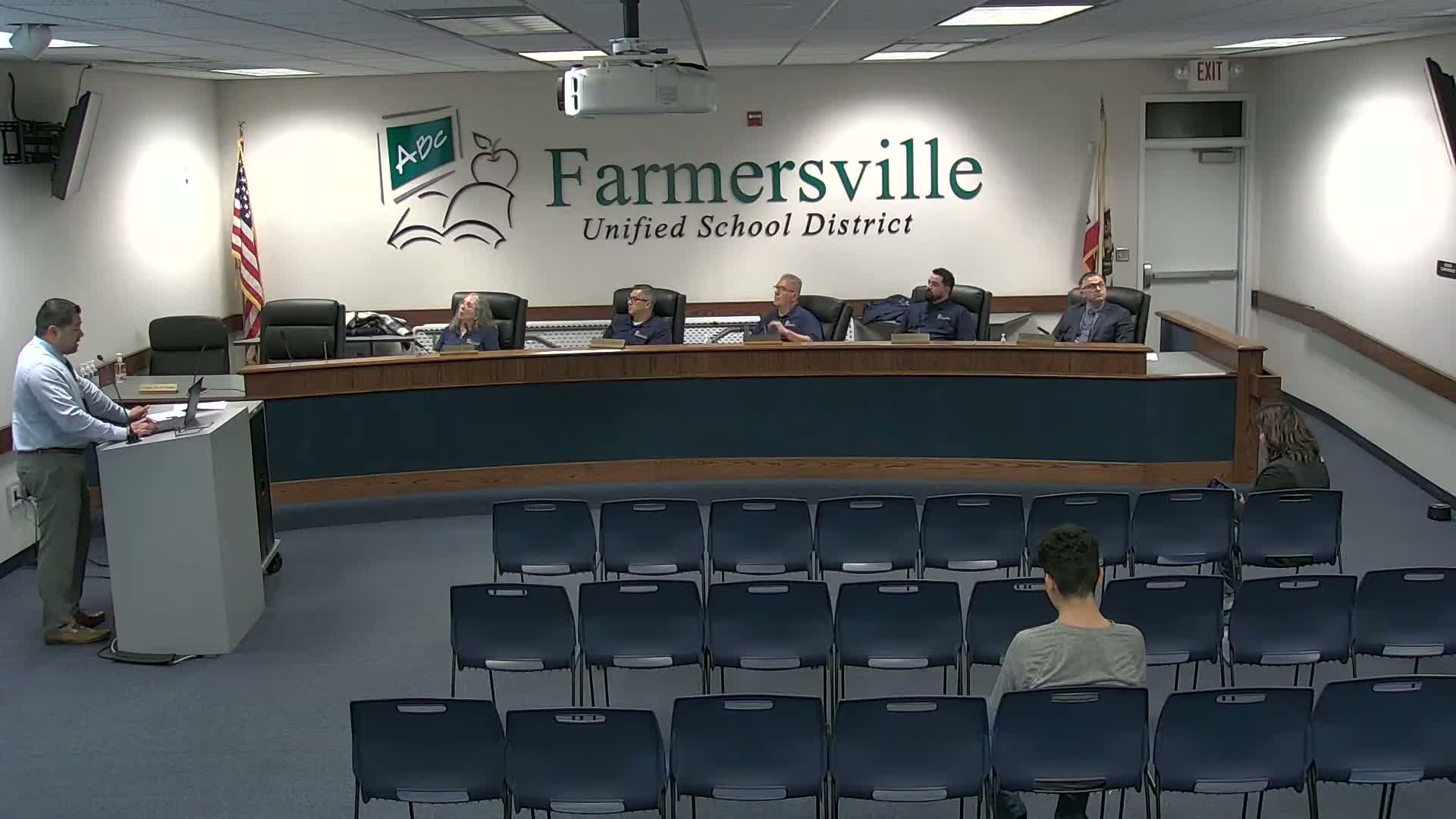
Summary
District presenters told the board the midyear Local Control and Accountability Plan shows roughly $37 million in LCFF funding, strong gains for English learners and college/career indicators, but negative growth for students with disabilities and homeless youth, leading to differentiated assistance from the county.
The Farmersville Unified School District presented its midyear Local Control and Accountability Plan (LCAP) update on district progress through December, outlining academic gains for some groups and targeted concerns for others.
The LCAP presenter told the board the district's LCFF (local control funding formula) is roughly $37,000,000, including about $11,000,000 in supplemental/concentration funds intended for low-income students, foster youth and English learners. "This midyear LCAP report became a requirement," the presenter said, and the slide packet accompanying the update was provided in board materials.
Why it matters: the district reported about a five-point increase overall on the CAASPP English-language arts measure and double-digit growth for English learners (just over 12 points), while college-and-career readiness rose about 6.5 percentage points. Those gains contrast with declines for two vulnerable groups: students with disabilities and homeless youth, which the presenter said showed negative growth and prompted a county-identification for differentiated assistance.
The presenter described the district's approach to identifying root causes, including "empathy interviews" conducted by social workers and psychologists to surface barriers tied to absenteeism, suspensions and academics. "We have another meeting tomorrow, to get to some root causes," the presenter said. The district reported 47 student reclassifications from English learner status through December and noted that long-term English learners are plateauing even as other English-learner subgroups improve.
On resource use, the presenter said about $7,400,000 is attributed to Goal 1 (academic excellence) with roughly $3,200,000 spent through December (about 43% of that goal allocation). For Goal 2 (comprehensive supports), officials said about $1,840,000 of a $5,000,000 allocation had been spent (approximately 37%), and that some expenditures are delayed for timing reasons (for example, contract payments for safety systems and summer school costs).
Board members asked for details about supports for homeless students and next steps. A board member asked who participates in the empathy interviews; the presenter replied that interviews are led by social workers and psychologists and that follow-up is handled by community liaisons and McKinney-Vento representatives at each school site.
Next steps: the district said it will continue the root-cause work with the Tulare County Office of Education, pilot K–6 math curricula through March with 14 participating teachers and reconvene the math-adoption committee in March to recommend a path forward. The board recorded the presentation and will track implementation of the LCAP actions scheduled for completion later in the school year.
No formal vote was required for the presentation portion of the meeting; the LCAP update was shared for board information and discussion.