Get Full Government Meeting Transcripts, Videos, & Alerts Forever!
Get email alerts on the Historic Preservation topic
No spam. Unsubscribe anytime.
Historic Commission pushes Mills Act exploration, unveils tours and plaque plans
Summary
Terry McTeer, chair of Grass Valley’s Historic Commission, outlined a five-part public-history plan including walking tours, an audio tour, a revised heritage booklet, commercial-building plaques and a consolidated history website; commissioners asked council to explore Mills Act incentives and directed staff to examine insurance and assessor implications.
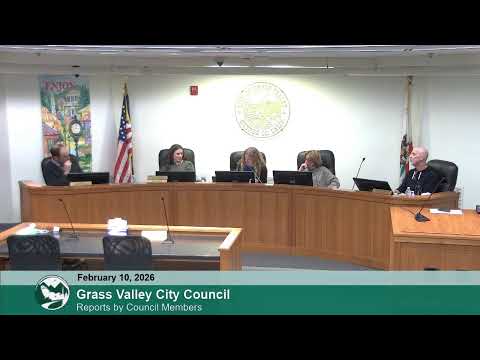
Terry McTeer, chair of the Grass Valley Historic Commission, updated the City Council on the commission’s quarterly work and urged council consideration of the Mills Act as a local tool to encourage preservation.
"I'm Terry McTeer. You're the chairman of the commission," McTeer said, and reviewed a five-pronged approach that the commission calls its public-history program: (1) guided walking tours, (2) an Arts Council–supported audio walking tour with professional voices and photographs, (3) an expanded heritage booklet adding chapters on commercial buildings and mural history, (4) an offer to place informational plaques on 20 selected commercial buildings, and (5) consolidation of existing walking-tour and history resources into a single city-accessible website or story map.
The commission reported modest fundraising from tours (about $1,500) and said it plans a History Day on May 9, funded in part by the county superintendent of schools, with multiple sites open for free. McTeer also briefed the council on unfinished commission projects including a Lake Olympia preservation review, bronze plaques for Walsh Mill and an old firehouse, and a request to acknowledge a narrow-gauge railroad trestle near Sutton and Idaho-Maryland.
The Mills Act, an established state mechanism that provides property-tax benefits to owners who agree to preserve historic properties, was a central topic. McTeer said the commission would like guidance from council and recommended inviting either the county assessor or representatives from Truckee (a nearby town that uses the Mills Act) to explain program implementation. Councilmembers raised concerns that adding plaques can sometimes trigger insurance-company scrutiny — one council member described a case in which insurers increased premiums after a business displayed a plaque — and asked staff to research the insurance and permitting implications before pursuing widespread plaque placement.
McTeer asked for direction on funding installation and maintenance of banners and signage; the commission said it can fund plaque production but needs guidance on installation costs and ongoing placement responsibilities. McTeer said staff member Miranda is building a story map of historic buildings for public access.
Councilmembers did not adopt a Mills Act ordinance at the meeting; several asked staff to return with options and suggested inviting other jurisdictions or the assessor to present models and potential tax-exemption formulas.