
Newberg-Dundee presents cautious, limited approach to classroom AI use
Get AI-powered insights, summaries, and transcripts
Sign Up Free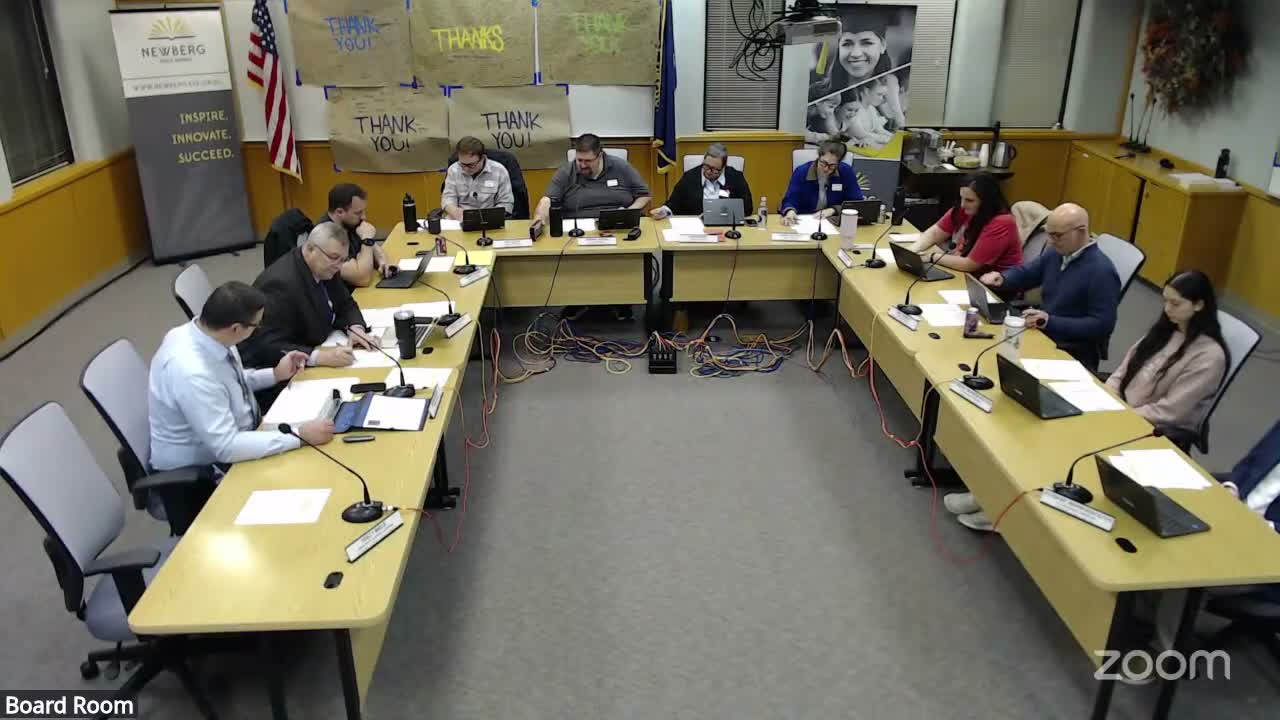
Summary
District presenter Holly told the board the district is embracing AI as a teacher planning and UDL tool, recommends limited classroom use for upper grades, discourages generative AI for elementary students and flagged student privacy and monitoring as priorities.
Holly, a district presenter, told the Newberg-Dundee School Board on Feb. 10 that the district is approaching artificial intelligence as a classroom tool that can support teachers’ planning and Universal Design for Learning (UDL) goals while urging caution for student use. "We are embracing this tool," Holly said, adding that AI can reduce barriers for students and multiply teacher preparation time.
The district has begun targeted professional development for secondary teachers and hosted presentations from local university faculty to introduce classroom applications, she said. Holly recommended vetted tools the district already supports — including Google’s Gemini and a classroom-focused platform called Magic School — and suggested using AI for rapid rubric feedback, sentence frames and formative practice rather than substituting student learning.
Students and board members raised concerns about misuse and privacy. A high-school student told the board that roughly "70% of AI used by students is not for their benefit," saying generative systems are often used as shortcuts rather than study tools. A board member pressed how the district would protect student data when students use school-managed tools; Holly said the district was working closely with IT staff to manage network access and monitor in-class use and that more concrete policies are needed to specify which tools will be permitted.
Board members and staff discussed next steps for policy and monitoring. Several members urged more professional development and pilot programs, exit data collection from trials, and clarifying student-data protections with the district’s filtering and account settings. Holly said the district is treating AI as an evolving area: guidance will change as tools and risks are better understood.
The presentation closed with an acknowledgement of trade-offs. Holly warned that elementary students are not currently appropriate users of generative AI while pointing to middle- and high-school pilot opportunities; student representatives suggested the district provide explicit training on how to use AI as a study tool. The board did not adopt a formal policy at this meeting but heard the presentation to inform a future policy and administrative regulation.