Get Full Government Meeting Transcripts, Videos, & Alerts Forever!
Get email alerts on the Quasi Judicial Procedures topic
No spam. Unsubscribe anytime.
Woodland Park board receives refresher on quasi‑judicial rules, disclosure and appeals
Summary
At a Feb. 10 workshop, Woodland Park Board of Review members received training from assistant city attorney Betsy Stewart on quasi‑judicial procedures, including conflicts of interest, ex parte communications, recordkeeping and appeals to Teller County; the board also unanimously approved Jan. 13 minutes.
WOODLAND PARK, Colo. — The Woodland Park Board of Review met Feb. 10 for a training workshop on quasi‑judicial procedures led by assistant city attorney Betsy Stewart of the firm Wilson, Williams, Feldman & Dittman.
Stewart told the four‑member board that quasi‑judicial matters require the panel to apply existing law to the facts of individual appeals or variance requests rather than make broad policy. "Any party that's before you ... hears the same evidence at the same time," she said, emphasizing that fairness and an even record are central to due process under the Fourteenth Amendment.
The presentation distinguished legislative actions — which set policy and typically move to planning commissions or city council — from quasi‑judicial proceedings, which are narrowly focused on applying building‑code provisions. Stewart outlined the board's responsibilities under the local code and the Pikes Peak Regional building code: hearing appeals of building‑official determinations, considering minor variances, and addressing contractor license complaints.
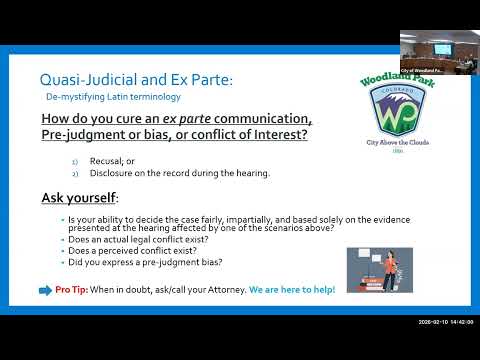
Stewart advised board members to avoid ex parte contacts outside the hearing and to disclose any relationships that could create a conflict. "If I had candy, I would give it to you," she said, agreeing with board member Jeff Cahill’s statement that, when a conflict exists, "you should recuse yourself." She recommended members call the attorney's office or staff in advance if they are uncertain whether to disclose or recuse.
On recordkeeping and deliberations, Stewart urged members to tie votes to specific legal factors from the packet so the board’s reasoning can be reviewed later. She described the typical appeal path: a party dissatisfied with a final decision may seek relief in the Teller County district court, often under Colorado Rule of Civil Procedure 106; Stewart said the usual filing period is 28 days and that courts apply an "arbitrary and capricious" standard that affords deference to board decisions.
The workshop also reviewed public‑comment procedures (commonly three minutes per speaker, one appearance), limits on independent research by members, rules for conducting noticed site visits (all members and the applicant should attend), and the narrow grounds and procedures for entering executive session and preserving attorney‑client privilege. Stewart cautioned that undocumented discussions or written communications about board business can become subject to public records requests.
Earlier in the meeting the board unanimously approved the minutes from its Jan. 13 session. Chair opened and closed the workshop and noted the training recording will remain available for orientation and new members.
The board adjourned after the training.