Get Full Government Meeting Transcripts, Videos, & Alerts Forever!
Get email alerts on the Small Business Lending topic
No spam. Unsubscribe anytime.
Allies for Community Business, CDFI Friendly Bloomington outline flexible loans, new $2.25M regional line
Summary
At the Feb. 11 Bloomington Urban Enterprise Association meeting, Allies for Community Business described loan products aimed at underserved entrepreneurs, including revenue-based financing and loans without conventional credit-score requirements, and CDFI Friendly announced a $2,250,000 regional line of credit and a March 5 webinar.
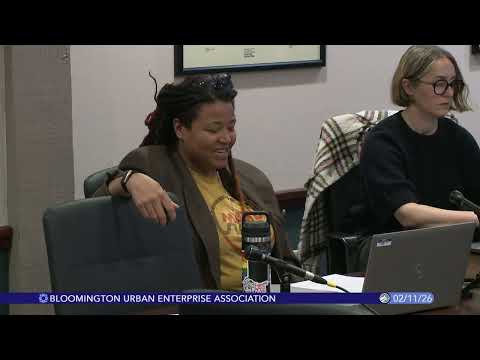
Allies for Community Business and CDFI Friendly Bloomington told the Bloomington Urban Enterprise Association on Feb. 11 that they are expanding flexible lending and technical-assistance options for local entrepreneurs.
Emma Yoder of CDFI Friendly Bloomington introduced the partnership, saying the nonprofit “connects small businesses, affordable housing developers, and child care providers with CDFIs” that provide flexible loans for underserved communities. She announced a webinar with Allies for Community Business set for March 5 at 11 a.m. to explain available products.
Brad McGowan, chief executive of Allies for Community Business, described three core lending products: small-term loans and lines of credit, and revenue-based financing for growth businesses. He said the organization makes loans ranging from $500 to $500,000 and typically does not rely on traditional credit scores for underwriting. “We don’t use credit scores at all,” McGowan said.
McGowan outlined pricing and structure: APRs for the organization’s products typically range from about 6% to 15% depending on size and risk, with an average APR “right about 9%,” inclusive of fees. For revenue-based financing, he said the product is designed for businesses with at least two years of history and roughly $250,000 in prior-year revenue; repayments are structured as a share of monthly revenue and generally end once the borrower has repaid roughly 1.25 times the financed amount over a five- to six-year period.
McGowan said the group intentionally subsidizes the difference between price and cost with philanthropic capital: “We intentionally lose money on every loan” and raise philanthropic funds to cover operating costs and expected loan losses, he said, so CDFI borrowers face lower all-in costs than they might from some alternative lenders.
Emma Yoder also announced two new lending partnerships meant to broaden capital availability: a $2,250,000 line of credit arranged with Old National Bank, German American, and First Financial that can support small business, affordable housing, and child-care lending across the region. Yoder said the program is being promoted via the Indiana Small Business Development Center and the Bloomington Chamber and asked board members to refer entrepreneurs.
The organization said it pairs lending with free coaching and program administration; McGowan noted average loan size is much smaller than its largest offerings (he said average loans are about $15,000) and that coaching and repayment flexibility are intended to retain entrepreneur wealth. McGowan encouraged local partners to rely on on-site, local coaching capacity while using Allies for supplemental services.
The presentation concluded with board questions about rates, fees and terms, and the group offered to share its credit-policy documentation and application materials with the board after the meeting.