Committee advances higher‑education research funding, rural jobs credits and multiple AI bills
Loading...
Summary
On Feb. 12, the House Economic Development and Workforce Services Committee advanced a package of measures, including a university research pilot funded from unearned performance dollars, an extension of a rural‑investment tax‑credit program, and three artificial‑intelligence bills focused on intimate image deepfakes and child‑safety protections for companion chatbots. Several measures received one or more dissenting committee votes.
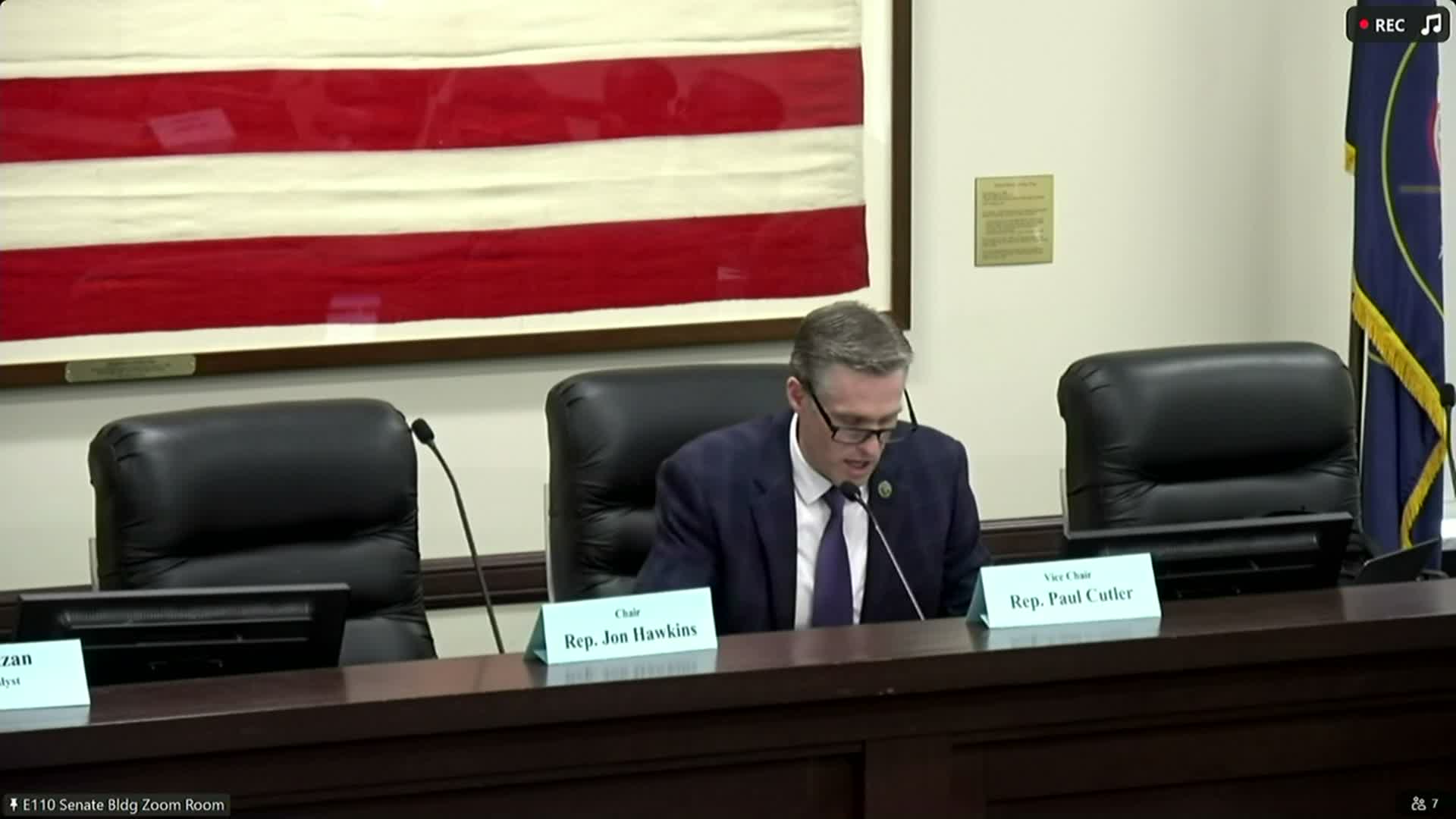
The House Economic Development and Workforce Services Standing Committee met Feb. 12 and advanced several bills aimed at boosting university research, supporting rural business growth and setting statewide guardrails for artificial‑intelligence products.
Representative Thomas W. Peterson told the committee HB 373 would create a pilot competitive grant program for Utah’s eight universities to leverage state funds as matching support for federal and private research grants. "We don't talk enough about the research that's happening at our institutions," the sponsor said, arguing the program would prioritize topics the committee approves — for example, critical minerals, water, AI, energy and life sciences — and use leftover performance‑funding dollars rather than new recurring state money.
Supporters including Jeff Moss (Governor’s Office of Economic Opportunity and Nucleus Institute) and Kelvin Cullimore (BioUtah) told the committee universities are a major economic engine for the state. Moss urged approval; Cullimore said, "R and D is really the fuel that drives innovation," citing life‑sciences job growth as an example. The committee adopted an amendment allowing administration costs to come from the same transferred account, and then favorably recommended HB 373 as amended; Representative Hansen recorded a dissenting vote on the recommendation.
The committee also moved forward HB 466, a reauthorization and modification of the Rural Jobs Act that uses investor tax credits to attract capital to businesses off the Wasatch Front. Alex Stepanek, a Vantage Capital executive, said the program fills a financing gap for manufacturers and other capital‑intensive rural businesses, enabling below‑market loans. The first substitute, which would broaden investor eligibility to include insurance‑premium tax credits, was adopted and the committee voted to favorably recommend HB 466 in a roll call recorded as 6–1.
On technology policy, the committee advanced multiple AI bills. Representative Ariel DeFe’s HB 276 (first substitute) targets nonconsensual AI‑generated intimate images by giving platforms a civil remedy and requiring provenance metadata to help users determine whether images are manipulated; sponsors said criminal laws already apply in some cases and this bill creates a private right of action for platforms. The committee adopted the substitute and a clerical amendment, and favorably recommended the measure with a recorded 5–1 vote.
Representative Roberts presented a coordination bill to rename and reorganize aspects of the Governor’s Office of Economic Opportunity and to require a coordinating council and reporting on opportunity‑zone designations. The measure, after substitute adoption and some procedural clarification, was favorably recommended in a roll call recorded as 7–1.
Representative Fiofi’s HB 438, aimed at companion chatbots, drew extended discussion. Sponsors described the bill as a narrow response to safety risks for minors: operators must allow users to download saved conversations, obtain consent before using sensitive personal data, clearly label paid or sponsored content, and provide frequent disclosures to minors that they are interacting with a chatbot; chatbots must also provide crisis resources if a minor expresses suicidal ideation. Department of Commerce and Office of AI Policy officials described a phased safe‑harbor and reporting approach for safety‑critical monitoring. The first substitute for HB 438 was adopted and favorably recommended by the committee in a roll call recorded as 8–1, with Representative Hansen voting No.
Public testimony during the hearing included state agency representatives and industry groups supporting the measures’ goals and urging careful, implementable rules. Margaret Willie Bussey (Dept. of Commerce) and mental‑health practitioners urged strong child‑safety provisions; local‑government representatives supported the coordination bill’s invitation for local participation.
Votes at a glance
- HB 373 (Higher education research pilot), first substitute as amended — amendment adopted; committee favorably recommended to the House (Hansen recorded as voting No). - HB 466 (Rural Jobs Act modifications), first substitute — adopted; committee favorably recommended to the House (roll‑call recorded 6–1). - HB 276 (AI, deepfakes/provenance), first substitute as amended — substitute and clerical amendment adopted; committee favorably recommended to the House (roll‑call recorded 5–1). - Roberts bill (development planning/coordination; GOEO name change/coordination council) — second substitute adopted; committee favorably recommended (roll‑call recorded 7–1). - HB 537 (Host committee sales of Olympic products), first substitute — adopted; committee favorably recommended (Hansen recorded as voting Nay on final recommendation). - HB 438 (AI companion‑chatbot amendments), first substitute — adopted; committee favorably recommended (roll‑call recorded 8–1, Hansen No).
What’s next
All measures the committee favorably recommended will be scheduled for consideration by the full Utah House of Representatives. Sponsors and agency staff said implementation timelines and technical details (for example, phased compliance dates for provenance disclosures and safe‑harbor testing protocols) will be refined in committee work and through agency rulemaking or interagency guidance where appropriate.
Reporting note: This account uses only statements and votes recorded in the committee transcript. Where the transcript reported a dissenting member by name, that is noted; fiscal‑note figures and program returns were summarized as presenters delivered them to the committee.