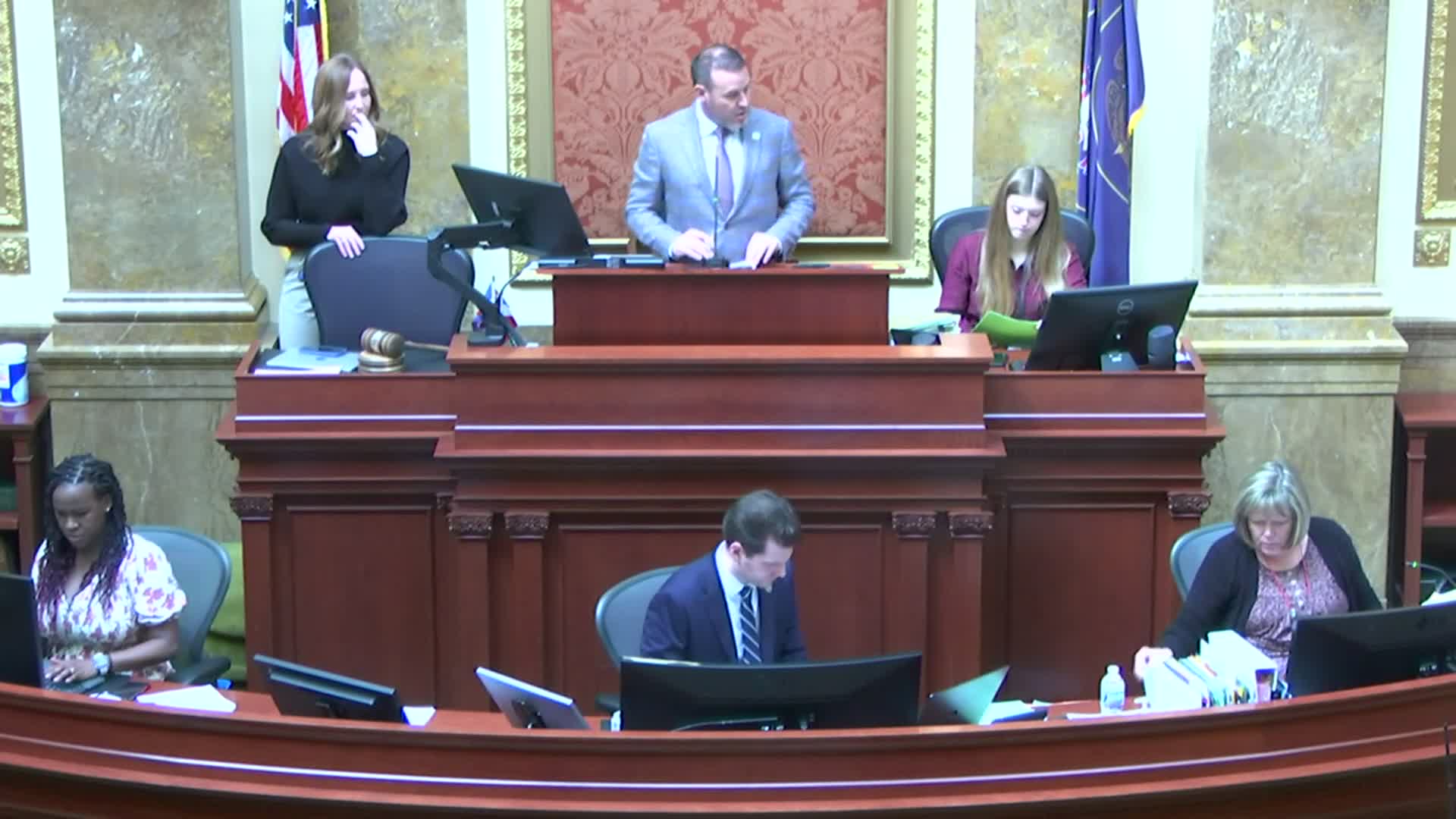
House advances broad package of bills on water, public safety, elections and forest restoration
Loading...
Summary
On Day 24 of the 2026 Utah General Session the House adopted a slate of committee reports and passed bills affecting water rights and storage, driver-training rules, signature-gathering procedures, forest restoration coordination, and several technical recodification measures. Several items drew extended floor debate and amendments.
The Utah House of Representatives on Feb. 12 advanced a wide-ranging set of bills covering water policy, public-safety protections for rental and commercial drivers, election petition rules and forest and watershed restoration work.
Representative Shallenberger, sponsor of a recodification package, described third-substitute SB 40 as “a large recodification effort” to consolidate business-entity codes into a common “hub and spoke” filing system; the House approved the substitute by voice and the third substitute SB 40 passed on third reading with 67 yes votes and one no. A companion measure, SB 41, which aligns code numbers to that recodification, was also placed before the body and advanced.
Water bills were a major focus. Representative Jack summarized second substitute HB 187 as a narrowly tailored change to preserve Utah’s rights in the Lower Colorado River Basin, giving certain water districts more time to develop reserved water rights; the bill passed 66–0 (recorded). Representative Chu explained first substitute HB 251 would allow certain historic diligence claims to be recognized if the underlying patent was occupied before 1903 and to apply a rebuttable presumption in contested cases; the House approved the bill (first substitute HB 251) with a recorded favorable vote. Representative Brooks said HB 349 establishes an explicit process to identify and evaluate reservoir sites — he said task forces had identified “over 800 reservoir sites” — and the House passed the bill for transmittal to the Senate.
A bill adding metal-theft responsibilities to a multi-agency strike force (first substitute HB 271) passed after the sponsor said reports on catalytic converter thefts would be routed to existing oversight bodies.
Forestry and wildfire work also moved forward. Representative Albrecht described HB 376 as creating a Utah Forest Restoration Institute at Utah State University to coordinate forest and watershed restoration and require annual legislative reporting; the sponsor stressed the bill’s role in wildfire mitigation and rural watershed protection and the House passed the measure.
On workforce and public safety, Representative Perucci sponsored HB 118 to require driver‑training schools to obtain an upfront attestation that commercial driver‑license (CDL) applicants are sufficiently proficient in English to comply with federal requirements. Supporters framed the bill as consumer protection and public-safety policy: Representative Watkins said enforcement has been inconsistent and the change “puts the check at the front end” to protect students from exploitation. Representative Romero urged caution, saying the measure could have a “chilling effect” on Latino communities and that her district’s residents might feel targeted. The House passed HB 118; the transcript records “58 yes votes” but the no‑vote tally in the record is not clearly specified.
The House also debated and approved HB 32, a package of signature-gathering and verification reforms. Representative Kautler said the bill requires training for signature gatherers, provides notification to signers when their signatures are verified, and creates a condensed packet with a QR code so signers can review the initiative text. Representative Shelley offered a second substitute to add a short pause prompting signers to contact their representative; the second substitute failed and the House approved the first substitute HB 32 (56 yes, 11 no).
Other votes: SB 52 (substitute-teaching flexibility) was described by sponsor Representative Tracy Miller as giving principals more discretion to use qualified paraprofessionals as long-term substitutes; the bill passed. HB 369 (agriculture cleanup), HB 378 (fugitive-dust mitigation), and HB 401 (a geothermal feasibility study with an adopted technical amendment) also passed and will be transmitted to the Senate.
Votes at a glance (selected items mentioned or voted on the floor): • SB 40 (third substitute) — business recodification: passed (67 yes, 1 no). • SB 41 — companion recodification measure: advanced/encircled and considered on the floor. • SB 52 — substitute-teaching requirements (gives principals more flexibility): passed (recorded unanimous in floor remarks). • HB 271 (first substitute) — multi-agency joint strike force (adds metal theft): passed (63 yes). • HB 187 (second substitute) — Colorado Basin water amendments: passed (66 yes). • HB 251 (first substitute) — diligence claims / water rights recognition: passed (68 yes as recorded). • HB 349 — statewide water storage/reservoir process: passed (63 yes, 1 no). • HB 369 — agriculture and food cleanup bill: passed (65 yes, 1 no). • HB 376 — Utah Forest Restoration Institute and land-management funding: passed (68 yes). • HB 118 — driver-training/CDL English proficiency requirement: passed (transcript records 58 yes; no tally not clearly specified in record). • HB 32 — signature-gathering and verification reforms (first substitute): passed (56 yes, 11 no). • HB 324 — Utah Marriage Commission fee amendments: passed (63 yes, 5 no). • HB 378 — fugitive-dust mitigation: passed (71 yes, 2 no as recorded). • HB 401 — geothermal feasibility study (amendment adopted): passed (61 yes, 10 no).
What changed next: passed bills will be transmitted to the Senate or, where appropriate, sent for enrolling and signature. The House recessed for a short break and scheduled a conference committee meeting referenced in communications from the Senate.
Key quotations from the floor: • Representative Shallenberger on the recodification: “This has been a large recodification effort… where they’re gonna have a uniform filing system.” • Representative Brooks on water storage: “We identified over 800 reservoir sites in the state and then narrowed it down of how we can really make these come to be.” • Representative Perucci on HB 118: the bill “protects public safety…and protects these students who may be taken advantage of by some of these schools.” • Representative Romero expressing concern: “There are a lot of people in my district who are just trying to survive… I think this is gonna limit their ability to provide for their families.”
What to watch next: transmitted bills moving through Senate committees (natural resources, transportation, law enforcement & criminal justice, and others) and any conference-committee work on HJR 1 referenced in Senate communications.