Get Full Government Meeting Transcripts, Videos, & Alerts Forever!
Get email alerts on the Education Ai topic
No spam. Unsubscribe anytime.
Parkrose students and teacher urge careful approach to AI as AVID program shows high college application rates
Summary
Students and staff described the AVID college-and-career program and reported high FAFSA completion and college-acceptance metrics; teacher Marissa Advaita urged caution on classroom AI use, citing studies she said show risks to student critical thinking and asking the district for guardrails and a conservative policy.
Parkrose School District students, staff and a veteran teacher used Monday’s working session to highlight the district’s AVID college-and-career program and press for a cautious approach to classroom use of artificial intelligence.
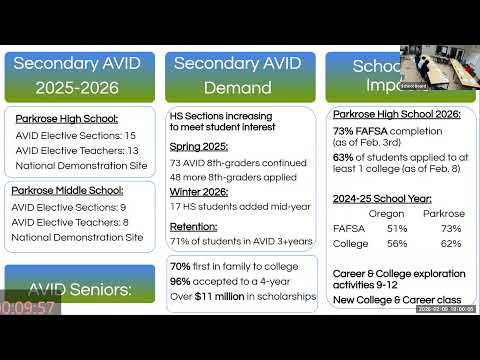
Students from Parkrose High and middle schools told the board that AVID helps them identify postsecondary pathways and build skills employers and colleges want. Presenters said roughly 73 percent of students had applied for the Free Application for Federal Student Aid (FAFSA) and reported that AVID sections include about 15 at the high‑school level and nine at the middle‑school level. One presenter said 96 percent of AVID seniors were accepted to four‑year colleges.
The presentation shifted into a teacher’s testimony on AI. Marissa Advaita, a high‑school teacher of 23 years, said recent research led her to worry that overreliance on generative AI can weaken students’ independent thinking. “There’s a study from NIT showing cognitive death is real when people use AI,” she said, adding that The Economist and other sources have raised related concerns about screen time and educational technology. “Students need to be their own thinkers. This is the biggest tool we can give them.”
Advaita told the board she supports teaching students about AI conceptually but urged the district not to adopt classroom AI tools wholesale without guardrails. “We should continue to teach students about AI, but not necessarily with AI,” she said, and recommended training for teachers, clear access limits, and policies that keep the district focused on instruction that develops critical thinking.
Board members and district leaders responded that they value the classroom perspective and that an internal action‑research team is studying technology literacy and AI impacts. Vice Chair Brenda Rivas praised the teacher for bringing classroom examples to the board. District leadership said a conservative policy recommendation around AI and technology literacy would be presented to the board before the end of the school year, after input from media specialists and teacher groups.
The session also included questions from parents and students about scheduling conflicts between AVID and advanced placement courses. Students described how limited class periods sometimes force choices between AVID and single‑period AP offerings; staff said the district tries to offer flexible options, and that some students leave AVID temporarily and rejoin later. Parents and board members indicated interest in visiting classrooms and reviewing the policy recommendations when they are ready.
The discussion closed with district leaders committing to present policy recommendations based on the research team’s findings and to continue engaging students and teachers as the draft policy is developed.