Ocean Township program ties job-embedded professional development to early gains in focus standards
Loading...
Summary
At a school board meeting, administrators described a job-embedded professional development initiative at the intermediate school that uses monthly focus standards, a shared instructional language and LinkIt assessments; presenters reported improvements in 13 of 16 focus standards and a district Padlet of lesson plans and resources.
At a board meeting, district staff unveiled an initiative to replace siloed professional development with monthly, job-embedded learning focused on shared, schoolwide instructional practices. The program, presented by Mr. Amato, aims for consistent classroom instruction across departments and uses a shared monthly theme, cross-department lesson planning and a living library of resources on a Padlet hosted in the district Google Classroom.
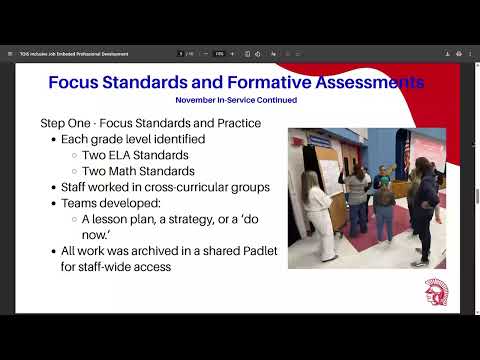
Mr. Amato said the district identified 16 focus standards (two per grade level) after summer analysis of prior years’ results and evidence statements. "I am pleased to announce that out of our 16 focus standards, we have gone up in 13 of them," he told the board. He described a three-part assessment cycle — Form A (September), Form B (recently completed), and Form C (April) — using LinkIt because it is a predictive, standards-aligned tool the district trusts to forecast NJSLA performance.
The initiative seeks broad staff participation: faculty meetings set a common theme, departments adapt practice around those themes and classroom teachers implement lessons; support and elective teachers also contribute. Mr. Amato described an example in which an art teacher and a math interventionist co-developed a lesson on functions that could be adapted across content areas. The Padlet, he said, contains teacher-created lesson plans and formative-practice notes that any staff member can access.
Board members praised the approach. Miss Gilman said the cross-department collaboration was "wonderful," citing the art/math example as the kind of lesson that shows subjects are not taught in isolation. Other board members suggested the model could scale to high school and elementaries if the trend continues. Presenters acknowledged the work requires staff buy-in and time, but said attendance trends and staff feedback show increased engagement in PD and PLCs.
Administrators emphasized the approach is culture-focused rather than program-dependent. Mr. Amato called it "inclusion without labels," saying it aims to make instruction more cohesive and collaborative districtwide. The presentation closed with the administration planning to continue analyzing Form B data and refine focus standards or interventions ahead of Form C in April.
The board did not take a formal vote on the initiative; discussion concluded with members commending staff and principals for the work and asking for continued updates on data and implementation.