
DHS officials display large drug seizures at Otay Mesa, warn department funding gap could affect operations
Get AI-powered insights, summaries, and transcripts
Subscribe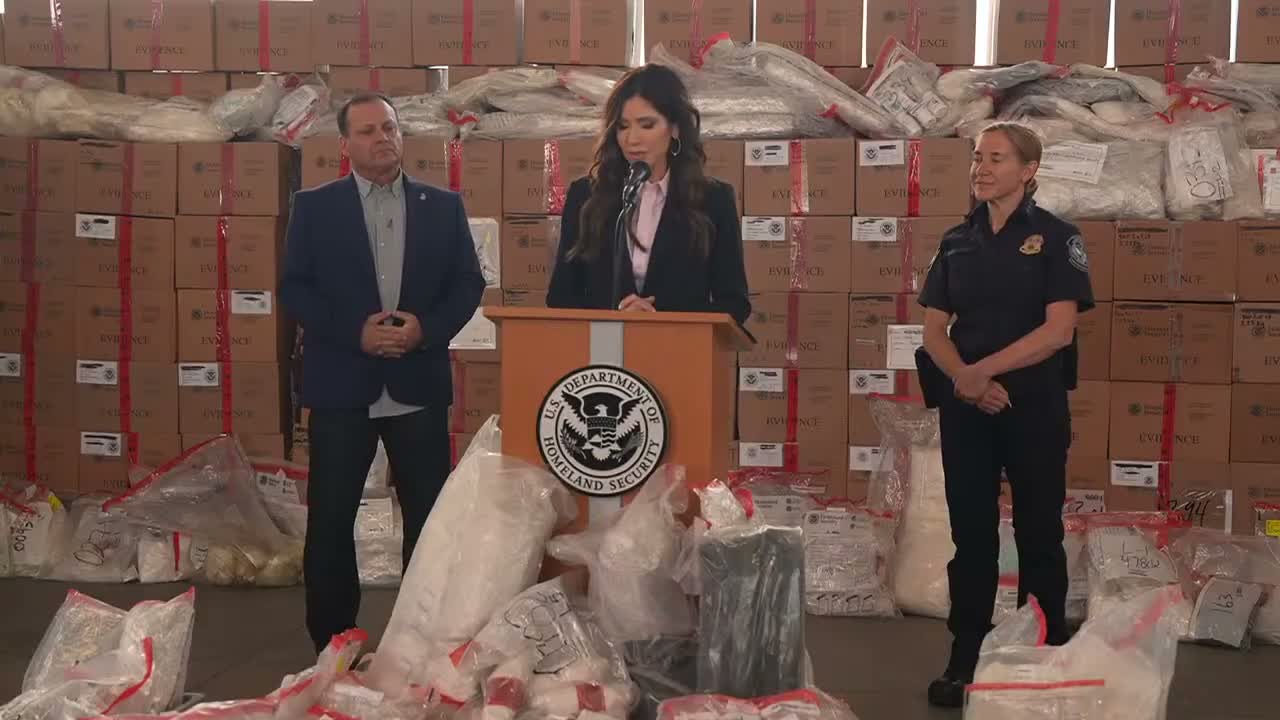
Summary
Department of Homeland Security officials displayed tens of thousands of pounds of seized narcotics at the Otay Mesa port of entry and warned that a lapse in congressional funding could disrupt TSA, FEMA and other DHS functions while urging state and local cooperation on detainers and 287(g) agreements.
At the Otay Mesa port of entry in San Diego, Department of Homeland Security Secretary Kristi Noem onstage with Customs and Border Protection officials displayed seized narcotics and highlighted enforcement results while warning that a funding lapse could disrupt critical DHS operations.
"You see enough lethal doses of fentanyl that would kill 10000000 Americans," Noem said while pointing to a bin of seized drugs on display, and she described a secure vault holding what she said was "188,218 pounds of seized illicit drugs," including "over a 100,000 pounds of meth, 59,000 pounds of cocaine, and 7,400 pounds of fentanyl." She attributed the seizures to CBP's San Diego-area operations.
The account put heavy emphasis on enforcement outcomes and partnership with local authorities. "A key to our success at the Department of Homeland Security is making sure that we're partnering with our local law enforcement," Noem said, thanking Sheriff Ken Jones and port director Rosa Hernandez for their cooperation. She also urged California officials to honor ICE detainers, saying ICE has lodged detainers on "over 33,000" people in California jails and that "over 4,500" criminal noncitizens were released under sanctuary policies.
U.S. Border Patrol Chief Michael Banks reiterated the scale of the seizures and operational changes he credited to the current administration, saying, "Enough fentanyl in front of me to kill 19000000 Americans," and asserting that "the United States Border Patrol has not released a single illegal alien in 9 months." Banks attributed higher interdiction at ports of entry to the return of Office of Field Operations officers to ports, allowing more inspections and use of equipment and technology.
Diane Sabatino of CBP's Office of Field Operations described anticipated uses of funding from what she called the "big beautiful bill act," saying the money would support nonintrusive inspection technology, responsible integration of artificial intelligence and hiring "more than 5,000 CBP officers" for ports of entry.
During a question-and-answer session, Noem declined to provide operational details that could endanger agents but described DHS work as "targeted operations" against individuals who threaten public safety. She also said that detainees in federal custody receive food and medical care and stated that those who choose voluntary return are given "$2,600 and a plane ticket" to return to their home countries.
Noem repeatedly warned that, as presented at the event, parts of DHS were at risk if Congress did not pass funding for the department: "If we had some kind of an attack or a terrible disaster... FEMA is the agency that's responsible" and "the TSA... won't be paid" if DHS is not funded. She listed other components that she said would be affected, including the Secret Service and the Coast Guard.
No formal actions or votes took place during the event. Officials urged federal-state-local cooperation, including work on 287(g) agreements with local law enforcement in places such as Minneapolis and other Twin Cities jurisdictions.
The event closed after officials answered questions and reiterated calls for funding and cooperation.